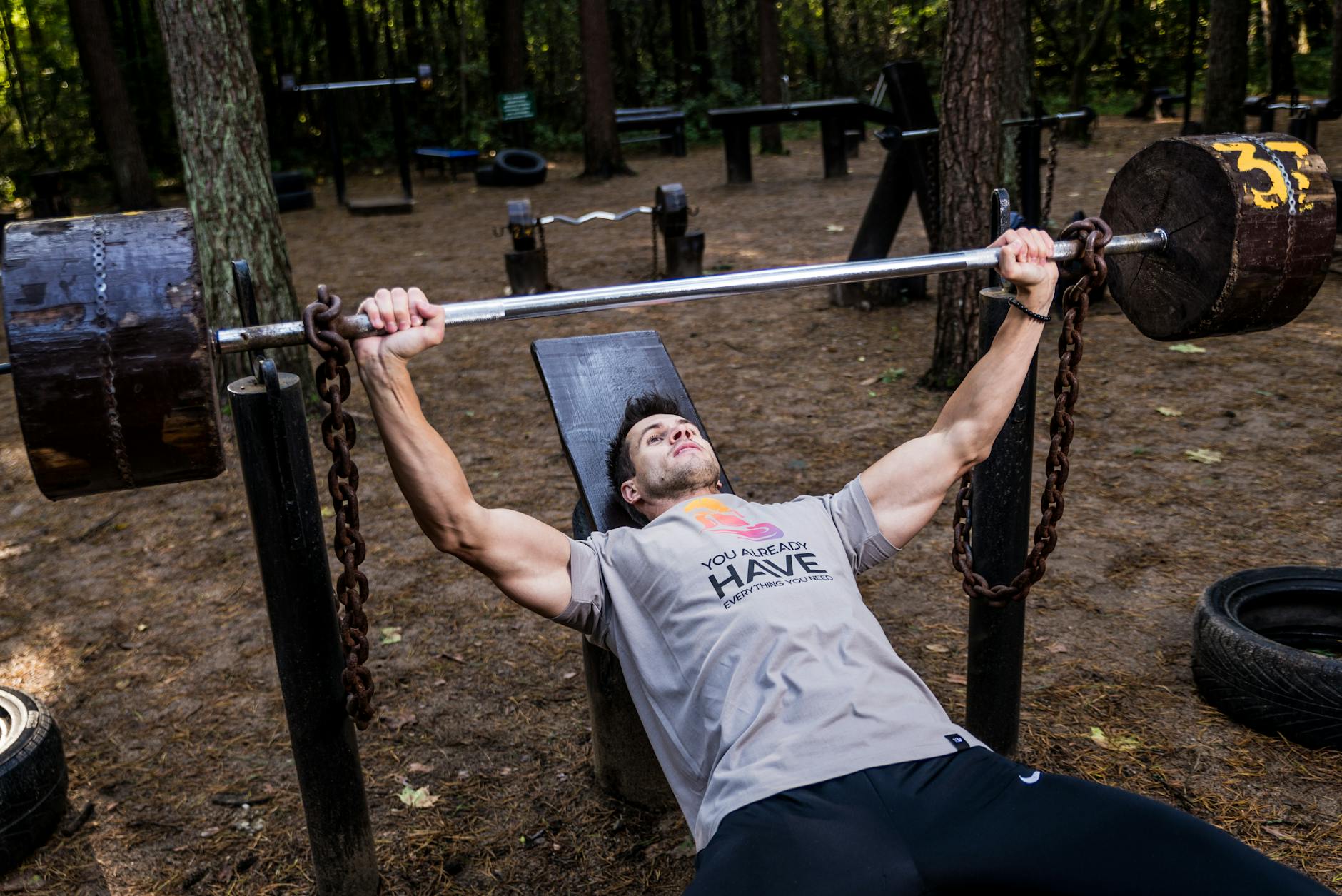
Training to failure feels productive. You pushed hard, you left nothing on the table, the set was brutal. The problem is that the productivity feeling doesn't translate to more muscle or more strength across weeks — it translates to more fatigue, slower recovery, and often worse results than a program that stops sets at RPE 8 or 9.
The modern hypertrophy research is clear on this: training within 1 to 3 reps of failure produces nearly identical hypertrophy to training at absolute failure, and does so at significantly lower fatigue cost. The strength research is similar — working at RPE 8 to 9 on heavy compounds produces better long-term strength progress than working at RPE 10 every set.
What happens at failure
When a set is taken to true concentric failure, several things occur:
- Neuromuscular fatigue spikes — the CNS has to work significantly harder to complete the final reps
- Form breaks down — the last 1 to 2 reps of a true failure set are rarely done with the bar path and bracing of the earlier reps
- Recovery time for the trained muscle extends by 24 to 48 hours compared to a set terminated 2 reps short of failure
- Next-session performance drops because full recovery hasn't occurred
The muscle stimulus of a failure set is only marginally higher than the stimulus of a set stopped at RPE 9. The fatigue cost, though, is substantially higher. Over a training week, failure sets produce about the same total hypertrophy stimulus as RPE 9 sets but cost twice the recovery capacity.
The specific research
Helms, Schoenfeld, and others have run multiple studies comparing training to failure versus stopping short. The hypertrophy outcomes are statistically equivalent in most comparisons. The strength outcomes favor stopping short, because higher-frequency training becomes possible when fatigue is lower.
A lifter training with RIR (reps in reserve) of 2 to 3 can train a muscle group 3 times per week. A lifter training to failure on the same muscle group usually can't train it more than twice per week because recovery extends. Over a full training block, the RIR-2 lifter accumulates 50 percent more training volume at equivalent per-set stimulus.
When failure training is appropriate
Failure training has a place. Specifically:
1. The last set of the last exercise
Taking the final set of your session to failure doesn't compromise the next workout because you're done with that muscle for the session anyway. The only cost is 24 to 48 hours of additional recovery, which you have if you're not training that muscle again for 72 hours.
Example: three sets of 8 at 185 on bench press, stop at RIR 2. Then bump down to 135 for a final set, rep out to failure — maybe 15 to 20 reps. This captures any additional hypertrophy benefit failure might provide without compromising the main working sets.
2. Isolation exercises, not compounds
Failure on a set of biceps curls carries minimal systemic cost. Failure on a set of squats carries massive systemic cost. The more systemic the exercise, the more expensive failure becomes.
A safe rule: never take compound lifts (squat, deadlift, bench, overhead press, row) to true failure in normal training. Leave 1 to 3 reps in reserve on every working set. Save failure work for isolation exercises (curls, lateral raises, leg extensions, tricep extensions, calf raises).
3. Deload or testing weeks
Periodic testing of your true rep maxes is legitimate and useful — but periodic. Once every 8 to 12 weeks, not every session. Take a 3-rep max to true failure, log the number, use it to calibrate working weights for the next block.
The fatigue math
If you train to failure on every working set, let's look at what a typical session actually costs:
Session: 5 sets of 5 at 85 percent squat. Each set taken to true failure (rep 5 is the last rep you could possibly complete).
Neuromuscular fatigue: severe. CNS dopamine and norepinephrine systems are depleted. Takes 72+ hours to normalize.
Muscle damage: severe. Legs likely sore for 3 to 5 days.
Next session quality: significantly reduced. Working weights drop 5 to 10 percent for 3 to 5 days.
Contrast with the same session at RIR 1 to 2 (stopping at what would be rep 6 or 7 if pushed to failure):
Neuromuscular fatigue: moderate. CNS recovers within 48 hours.
Muscle damage: moderate. Soreness peaks at 48 hours, resolved by 72.
Next session quality: mostly normal. Working weights maintained.
Over a 4-week block, the RIR-1 lifter hits the squat 8 times at near-full output. The failure lifter hits the squat 6 times with degraded output. The RIR lifter accumulates more productive volume.
Proximity to failure and RPE
Rather than training to failure or to a fixed RIR, most serious lifters use RPE — rate of perceived exertion on a 1 to 10 scale.
- RPE 10: true failure. Could not complete another rep.
- RPE 9: 1 rep in reserve. Could complete 1 more rep if absolutely needed.
- RPE 8: 2 reps in reserve.
- RPE 7: 3 reps in reserve.
Most productive working sets should land at RPE 7 to 9. RPE 10 is reserved for rare cases — testing, final sets of sessions, specific competition prep. Even elite powerlifters spend the majority of their training at RPE 7 to 9, not at RPE 10.
The RPE skill
Accurate RPE requires practice. Most lifters early in their training overestimate their RPE — they call a set RPE 9 that was actually RPE 7. This leads to under-training. Others under-estimate — they call a set RPE 7 that was actually RPE 9, leading to accumulated fatigue they don't track.
Calibrate RPE once every 2 to 3 weeks by taking one set to true failure (on an isolation exercise, end of session). Compare your internal sense of "almost failed" to actual failure. This recalibrates your RPE sense and improves training precision.
The hypertrophy exception
There's one context where failure-like training earns more of a place: late-set hypertrophy drops, on isolation exercises, for small muscle groups. Specifically, if you're chasing max biceps hypertrophy, the last set of a curl session can legitimately be taken to genuine failure plus mechanical drops (rest-pause, strip sets).
The cost on a biceps curl failure set is minimal — the CNS isn't stressed, the system doesn't accumulate much global fatigue, and the extra metabolic stress of the drop sets captures a hypertrophy pathway that RIR work might leave underexplored.
This doesn't apply to compounds. Drop sets on squats are a bad idea. Drop sets on lateral raises are fine.
What to do instead
Practical framework for an intermediate lifter:
- Compound lifts: all working sets at RIR 1 to 2 (RPE 8 to 9). Never to failure.
- Main accessories (chest-supported rows, dips, dumbbell presses, RDLs): RIR 1 to 2 on most sets, RIR 0 (failure) on the final set only
- Isolation work: any rep scheme, last set or two can legitimately hit failure and include drop techniques
- Periodic testing: every 8 to 12 weeks, take a single 3-rep or 5-rep max to failure to recalibrate training loads
Run this pattern for a 12-week block and compare to the previous 12 weeks of training to failure on everything. The progress will typically be faster, joints will feel better, and you'll have trained more total sessions with full output.
Failure feels productive in the moment. Across weeks, it's usually a tax rather than a benefit.