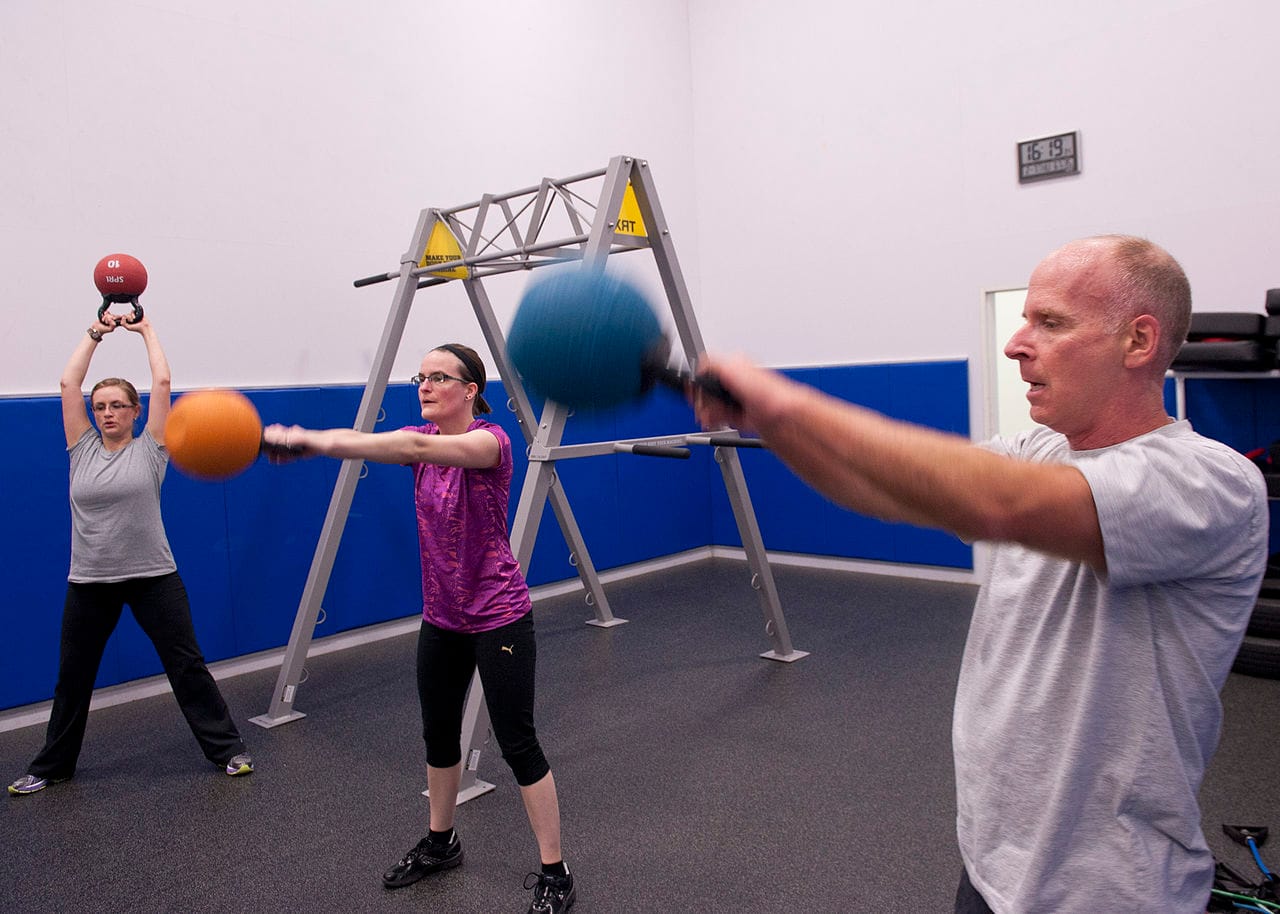
The kettlebell community has a marketing problem. For twenty years, various instructor certifications and Pavel Tsatsouline acolytes have claimed that kettlebells will replace your entire gym, make you stronger than powerlifters, fix your back, and extend your life by a decade. The claims went beyond reasonable. The backlash followed — kettlebells became associated with fitness hype rather than legitimate tools.
Here's the sober version. Kettlebells are not a complete training system. Barbells will build more strength and muscle for most lifters. But three specific kettlebell exercises solve problems that barbells don't address well. Knowing which three is worth more than another internet article about the "kettlebell revolution."
Problem one: posterior chain conditioning
The kettlebell swing is the most useful conditioning exercise ever invented. One tool, one movement, and you can train hip hinge patterning, posterior chain power, cardiovascular capacity, and grip strength simultaneously.
A 20-minute session of heavy swings — say, 10 rounds of 10 swings with 32-40 kg on the minute — produces a conditioning effect that most barbell work can't match. Your heart rate climbs into the 160-180 range. Your posterior chain (glutes, hamstrings, spinal erectors) works hard under load. Your grip gets tested. And unlike running or cycling, you're not impacting joints with repetitive stress.
For a strength-focused lifter who needs conditioning but hates jogging, kettlebell swings are close to the perfect solution. They don't interfere with squat or deadlift recovery the way running does (or at least, much less than running does). They fit into 20-minute sessions. They build work capacity that transfers to heavier deadlift sessions.
The catch: most lifters do swings wrong. The swing is a hip hinge, not a squat. The bell should float into position on the upswing (via hip drive), not be lifted by arm strength. If your swings look like front raises, you're doing them wrong and getting 30 percent of the benefit.
How to do it right
- Start position: feet shoulder-width, bell on the ground a foot in front of you
- Hinge (not squat) to grab the bell, back flat, weight on mid-foot
- Hike the bell back between your legs like a football hike
- Drive through your heels and explosively extend your hips
- The bell floats up to approximately shoulder height via hip drive
- The bell falls, you hinge again, repeat
Weight: men should work with 24 kg as a minimum working weight, 32 kg as a standard, 40+ kg for hard conditioning sessions. Sets of 10-20 reps. Rounds for time or on the minute.
Problem two: shoulder stability and coordination
The Turkish get-up is one of the strangest-looking exercises in the gym and one of the most valuable. You start lying on your back holding a kettlebell overhead, then progressively work your way to standing while keeping the bell locked out overhead the entire time. It takes about 30-45 seconds per rep.
What it trains: shoulder stability in multiple planes, rotator cuff coordination, core anti-rotation, hip flexor and hip mobility, and the general motor control to support an external load while moving through multiple body positions.
Why it matters for barbell lifters: bench press and overhead press train pressing strength, but they train it in a very limited range of positions. Your shoulders under a heavy bench exist in one plane of motion. When you injure your shoulder, it's usually not from bench pressing — it's from catching yourself during a slip, reaching awkwardly, or moving heavy objects in unfamiliar positions. The Turkish get-up trains the in-between positions.
One to three get-ups per side, twice a week, with a challenging weight (24-32 kg for most men after they have the movement pattern), is enough. This isn't a conditioning exercise. It's a skill and stability exercise.
Problem three: squat patterning and mobility
The goblet squat — holding a kettlebell against your chest while squatting — is the best teaching tool for squat patterning that exists. You get feedback on posture (if you round forward, the bell pulls you down), depth (easier to hit true depth than with a loaded barbell), and ankle and hip mobility (the counterweight helps you sit between your knees).
Who benefits: anyone who struggles with squat form, anyone returning from a layoff, anyone with mobility restrictions that prevent a good barbell squat.
How to program it: 2-3 sets of 10-15 reps with a moderate-heavy kettlebell (24-32 kg) as a warmup before your main squat work, or as a main movement on a lighter day. This is not going to build maximal leg strength (you can load barbells heavier), but it'll build squat quality and keep your pattern clean.
For lifters with back issues who can't barbell squat heavy, the goblet squat can be a long-term main squat. You won't build a 500-pound barbell squat with goblet squats, but you'll maintain leg strength and mobility without the spinal load.
What kettlebells don't do well
Kettlebells are a real tool that solves real problems. They're not magical or superior to barbells for most training goals. Specifically:
- Maximal strength: You can only buy kettlebells up to about 48-52 kg commonly. You'll outgrow this weight on any major lift within 12 months. Barbells scale infinitely.
- Hypertrophy of specific muscles: Kettlebell cleans and snatches don't isolate biceps, triceps, lats, or chest the way barbell or dumbbell work does.
- Complex programming: Kettlebell-only programs run out of progression options quickly. Once you're doing 32 kg for high reps, the next step is vague.
The integration works: barbells are your main tool, kettlebells fill three specific gaps. Swings for conditioning, get-ups for stability, goblet squats for patterning. Skip the rest of the kettlebell catalog (snatches, clean-and-jerks, complexes) unless you're competing in kettlebell sport, which most people aren't.
A simple integration
If you're running a barbell program and want to add kettlebell work without disruption:
- Monday (squat day): Goblet squats as warmup, 2x12 with 24 kg
- Wednesday (bench day): Turkish get-ups after main work, 3 per side with 24 kg
- Friday (deadlift day): Kettlebell swing conditioning after main work, 10 rounds of 10 with 32 kg on the minute
That's three specific kettlebell additions, each targeting a real problem. Total added training time per week: about 20 minutes. Not a kettlebell program. Not a revolution. Just three useful tools integrated into barbell training.
The bigger point
Most training debates work better as addition than subtraction. Kettlebell people argue against barbells. Barbell people dismiss kettlebells. Meanwhile, the smart lifter uses barbells as the foundation, adds kettlebells for specific problems, and throws in bodyweight work when convenient.
Don't be tribal about your tools. Use whatever works. Barbells are superior for strength. Kettlebells are superior for specific conditioning and mobility work. Both have a place in a serious training program. The cross-training effect is the point — stop arguing about which tool is better.