The classic deadlift plateau: you've pulled 405 for a triple, your back feels fine, your setup looks clean, but every attempt at 425 dies at mid-shin because the bar slips out of your hand. You think it's a back problem. It's a grip problem. And grip is the easiest thing in the entire deadlift ecosystem to fix — except that almost nobody actually trains it.
Fifteen minutes of grip work twice a week, run for 8 to 12 weeks, reliably adds 20 to 40 pounds to a deadlifter's max because it exposes strength that was already in the back but couldn't be transmitted to the bar. The return on investment on grip training is lopsided in its favor — which makes it strange how few programs include it.
Why grip limits deadlifts specifically
In a deadlift, the grip has to hold a bar that's being pulled away from the body across the entire range of motion. At 90 percent of your deadlift max, the forearms are at nearly maximum contraction for the 4 to 6 seconds the rep takes. The moment any single finger flexor starts to give, the bar rotates in the hand, the fingers open, and the lift fails.
In a squat or bench press, grip isn't the limiter because the bar is either on your back or locked into your hands against your chest. The force isn't trying to pull the bar out of your hands. Deadlifts are unique in this — which is why grip training specifically benefits deadlift numbers more than any other lift.
How to tell if grip is your problem
Test: use lifting straps on your next heavy deadlift session. If your deadlift with straps is 20+ pounds higher than your max without straps, your grip is the limiter. If straps don't meaningfully change your numbers, grip isn't the issue — look somewhere else.
Most intermediate deadlifters have a 20 to 40 pound gap between strapped and unstrapped deadlifts. Advanced lifters have a smaller gap (10 to 20 pounds) because they've done grip work. Elite lifters often have nearly zero gap — their grip matches their back.
Grip types that matter
Crushing grip
Closing the fingers against resistance. This is what holds a barbell. Trained by farmer's walks, heavy carries, captains of crush grippers, and dead hangs with added weight.
Supporting grip
Holding a load for time. This is what a deadlift actually demands — holding a heavy bar static for the duration of the lift. Trained by timed holds and long-duration farmer's walks.
Pinch grip
Holding a wide object without wrapping fingers under. Less relevant for deadlifting, more relevant for strongman work and general hand strength. Trained by plate pinches.
For deadlift-specific training, crushing grip and supporting grip matter most. The other types are bonus benefits if you include them.
The 15-minute protocol
Run this twice a week, separated by at least 48 hours:
Movement 1: Heavy farmer's walks
- Dumbbells or farmer's walk handles, 60 to 75 percent of your deadlift max total (so 300 pounds for a 450-pound deadlifter — 150 per hand)
- Walk 20 to 30 yards without setting down
- 4 sets, with 2-minute rests
Movement 2: Dead hangs
- Pull-up bar, bodyweight only initially
- Hang for maximum time, usually 45 to 90 seconds at the start
- 3 sets, with 2 to 3 minute rests
- Progress by adding weight (belt) once you can hang for 60+ seconds bodyweight
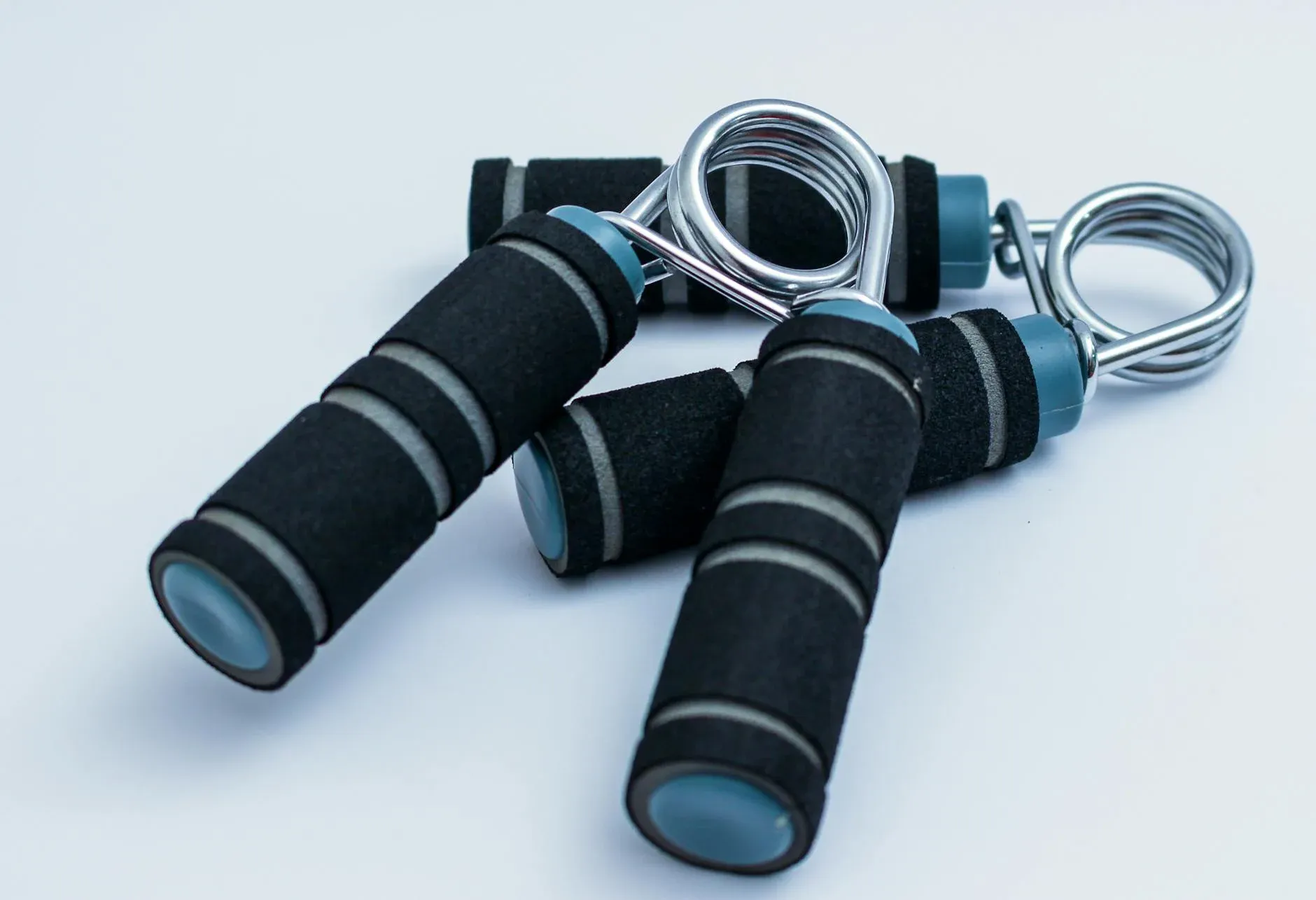
Movement 3: Captain of Crush grippers
- IronMind Captains of Crush grippers, the tool that established serious grip training as its own discipline
- Start with the #1 (140 lbs of resistance), progress to #2 (195 lbs)
- 3 sets of max reps each hand, 60-second rests
Total time: roughly 15 minutes. Two sessions per week. That's it.
The double overhand vs mixed grip question
Most lifters deadlift with a mixed grip (one hand over, one under) because it prevents bar rotation. That's fine — it's a legitimate competition grip. But if your training is entirely mixed grip, you're under-training your grip directly. The mixed grip lets you pull heavier with less grip capacity.
Solution: do your top-end deadlift work with mixed grip, but do your back-off sets and any volume work with double overhand. The double overhand forces the grip to work, and you'll see faster grip improvements.
Hook grip as an alternative
Hook grip (thumb under fingers) is how Olympic lifters hold the bar. It's stronger than double overhand and more balanced than mixed grip. The downside: it hurts. Like, actually hurts, particularly the first few months. Most powerlifters don't adopt it for this reason.
If you can tolerate the discomfort, hook grip is probably the optimal technique for heavy training. Your thumb takes the brunt of the load, but the structural advantage is real.
Chalk and straps
Chalk is not optional for serious deadlifting. It absorbs moisture and creates friction between bar and palm, which meaningfully increases grip security. Every serious gym either provides chalk or allows personal chalk. If your gym doesn't, consider that information about whether this gym is serious about lifting.
Straps: use them for volume work above 80 percent of your max, or when pulling a second session in a week and your grip isn't recovered. Don't use them for single-rep max attempts — if you pull 500 with straps, your actual strap-less deadlift is probably 470. The number on your meet platform is the strap-less number.
The everyday grip
Beyond structured work, grip benefits from everyday loading. Carry your groceries in single heavy bags rather than two lighter ones. Use one hand on heavy objects rather than two when possible. Pick up heavier things. The forearm has high capacity for handling low-intensity, high-frequency loading — which is why farmers and manual laborers historically had grips that made gym lifters look weak.
The towel pull-up
Loop a towel over a pull-up bar and do pull-ups holding the towel instead of the bar. This develops crushing grip at a completely different angle than anything else you're doing, and it's a brutally effective movement. Start with a single towel, work up to two towels (one per hand).
Your deadlift after grip training
Run the 15-minute protocol for 8 weeks alongside your normal training. When you re-test your deadlift max, expect 20 to 40 pounds on top of your previous number — not because your back got stronger but because you can finally hold onto the weight your back could already pull. For most stuck intermediate deadlifters, this is the fastest PR they've seen in years.
The whole grip ecosystem is the cheapest, highest-ROI thing in strength training, and almost nobody does it consistently. Be the guy who does, and watch what happens to your pulls.