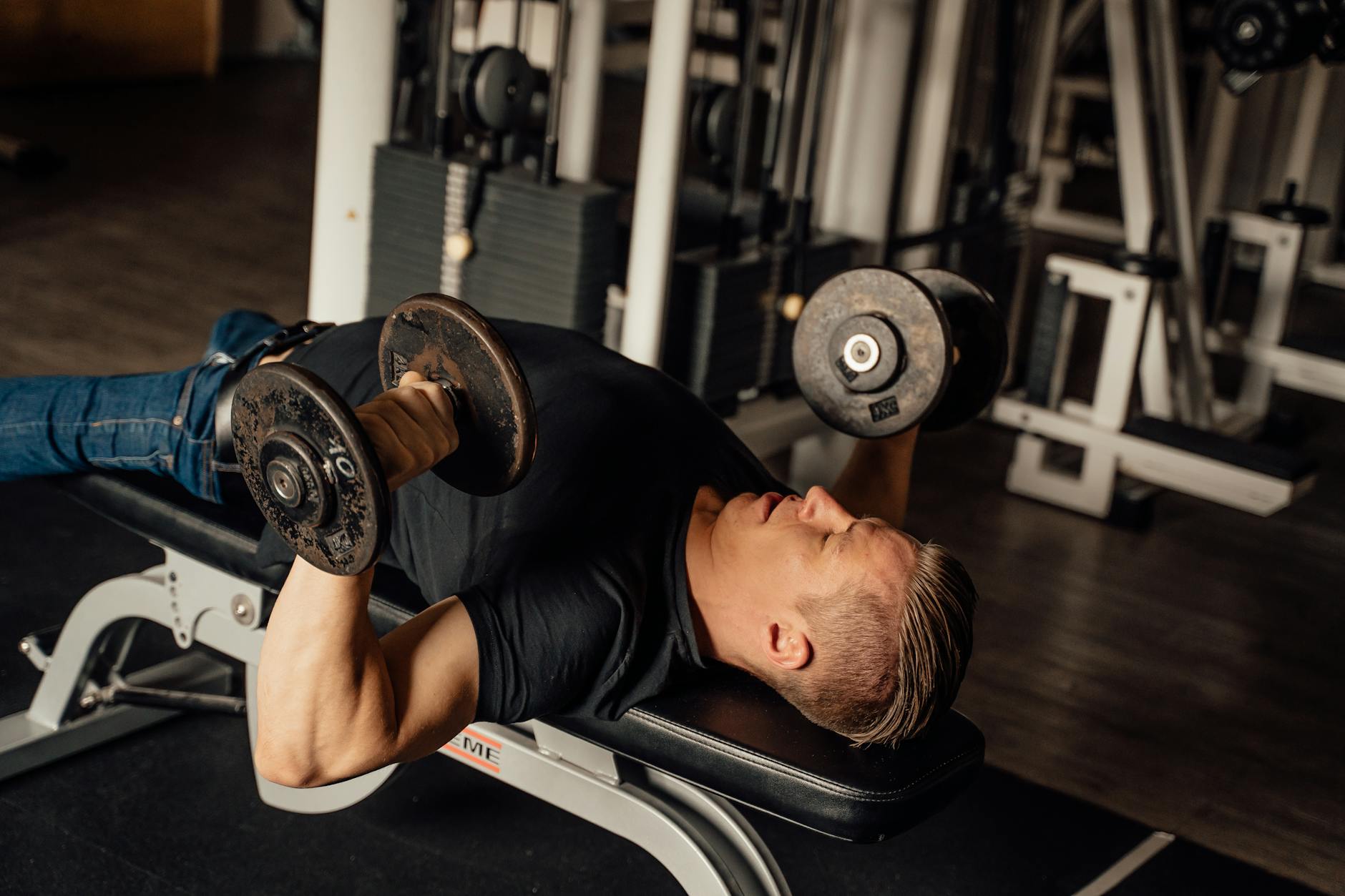
The split debate in training forums has been running for 30 years. Push/Pull/Legs has the momentum currently — YouTube thumbnails and Reddit routines are full of "optimal PPL" templates. Upper/Lower is older, quieter, and in many cases better for the actual lifters doing the training.
The real question isn't which split is theoretically better. It's which split hits appropriate weekly frequency per muscle at a volume you can actually recover from, given your schedule and life. For most men over 30 training 3 to 5 days a week, Upper/Lower wins that comparison decisively. PPL wins only in a narrower band of situations than its popularity suggests.
What each split actually is
Push/Pull/Legs breaks training into three categories:
- Push: chest, shoulders, triceps
- Pull: back, rear delts, biceps
- Legs: quads, hamstrings, glutes, calves
Run either once per week (3-day PPL) or twice per week (6-day PPL). The 6-day version is the popular one on YouTube, with high volume per session and each muscle group trained twice weekly.
Upper/Lower breaks training into two categories:
- Upper: all upper body (chest, back, shoulders, arms)
- Lower: all lower body (quads, hamstrings, glutes, calves)
Typically run 4 days a week — two upper sessions, two lower sessions. Each muscle group trained twice weekly.
The frequency math
Both splits can hit twice-weekly frequency per muscle — which the hypertrophy research converges on as optimal for most trained lifters. The difference is how.
6-day PPL: 2x per muscle, across 6 sessions. Higher per-session volume because each session covers only 3 muscle groups deeply.
4-day Upper/Lower: 2x per muscle, across 4 sessions. Lower per-session volume per muscle because each session spreads across all muscle groups.
Total weekly volume can be equal — say 16 sets of chest work weekly. The difference is whether those 16 sets come as 8 per session across 2 sessions (Upper/Lower) or as 6-8 per session across 2 push sessions (PPL).
Per-session fatigue
A good push session in PPL style hits chest, shoulders, and triceps with 6-8 sets each — total 20-ish working sets. That's a substantial session and typically requires 75 to 90 minutes.
A good upper session hits 8 sets chest, 8 sets back, 4 sets shoulders, 3-4 sets arms — total 24 working sets in 75 to 90 minutes. Similar total volume, but spread across more muscle groups.
The Upper/Lower session is lighter per muscle group within the session but more diverse. This has both pros and cons.
Why Upper/Lower usually wins for recreational lifters
Four reasons Upper/Lower suits most men training with real schedules:
1. Time demand
Upper/Lower at 4 days a week totals 4 to 5 hours of gym time weekly. PPL at 6 days a week totals 7 to 9 hours. The 3 additional hours per week are real, and they're the reason most 6-day PPL programs get abandoned by week 8.
For a married lifter with kids and a job, 4 training days is often the realistic ceiling. Not because 5 or 6 is impossible — because the 5th and 6th day consistently get skipped, and a program that depends on them fails.
2. Recovery demands
6-day training means 48 hours between same-muscle sessions in many patterns. For a 35-year-old with good recovery, that's fine. For a 45-year-old or anyone with elevated life stress, 72 hours between same-muscle sessions (Upper/Lower pattern: train upper Mon/Thu) recovers better.
Under-recovered training is worse than missed training. If your PPL schedule has you training chest Monday and again Thursday, and you're not fully recovered Thursday, your Thursday chest session is producing worse stimulus than one clean session per week would.
3. Fewer "specialty" sessions
PPL creates specialty sessions — a dedicated arm day, a dedicated leg day. These are easier to skip when life gets busy ("I'll just miss arms this week"). Upper/Lower distributes the same muscle groups across sessions that are more equivalent in importance. Missing one is equally costly.
4. Compound lift frequency
Upper/Lower naturally has squat and bench press showing up twice a week. PPL typically has each main lift once per week — which is not ideal for strength development as much as it is for pure hypertrophy.
If you care about strength progress on the compound lifts alongside hypertrophy, Upper/Lower supports it better.
When PPL is the right choice
PPL makes sense when:
- You can genuinely train 5 to 6 days per week consistently
- Your primary goal is pure hypertrophy, with strength secondary
- You're under 35 with good baseline recovery
- You have 75 to 90 minutes per session reliably
- You enjoy longer sessions focused on specific muscle groups
For a 25-year-old college student with flexible time and a focus on physique goals, 6-day PPL is a solid choice. For a 45-year-old attorney training around a demanding schedule, it's usually a mismatch.
The 3-day PPL option
A 3-day PPL (once per week per muscle) is generally suboptimal for hypertrophy — once-weekly frequency underperforms twice-weekly at matched volume in most studies. The 3-day PPL exists mostly for lifters who can only train 3 days a week and want to split muscle groups for variety.
If you can only train 3 days, a full-body template is usually better than 3-day PPL. Full body hits each muscle group 3 times per week at lower volume per session, which captures the frequency advantage.
The hybrid option
A 5-day upper/lower/push/pull/legs hybrid exists and works well for intermediate lifters who can train 5 days. It combines upper/lower frequency (chest and back hit twice weekly on the upper day + push/pull days) with leg day specificity.
Template:
- Monday: upper (compound bench, compound row, OHP)
- Tuesday: lower (squat, RDL, accessories)
- Thursday: push (volume work for chest and shoulders)
- Friday: pull (volume work for back)
- Saturday: legs (hypertrophy work, less heavy compound)
This gives you compound lift frequency twice a week plus dedicated hypertrophy sessions. It's the split I've had the most personal success with over the past 3 years at age 40.
Making the decision
Ask these honestly:
- How many days a week can I train without missing sessions? (Not want — can I)
- What's my minimum realistic session length?
- Is my primary goal strength, hypertrophy, or both equally?
- How good is my recovery (sleep, food, stress)?
If you can't commit to 5+ days, the choice is made for you — Upper/Lower or full-body. If you can, the question is whether your recovery supports 6 days of gym work without turning your weekdays into a series of exhausted wake-ups.
Most lifters' answer to the recovery question is no. That's why Upper/Lower at 4 days a week has been producing quietly excellent results for 30 years while PPL programs get promoted, attempted, and abandoned at higher rates.