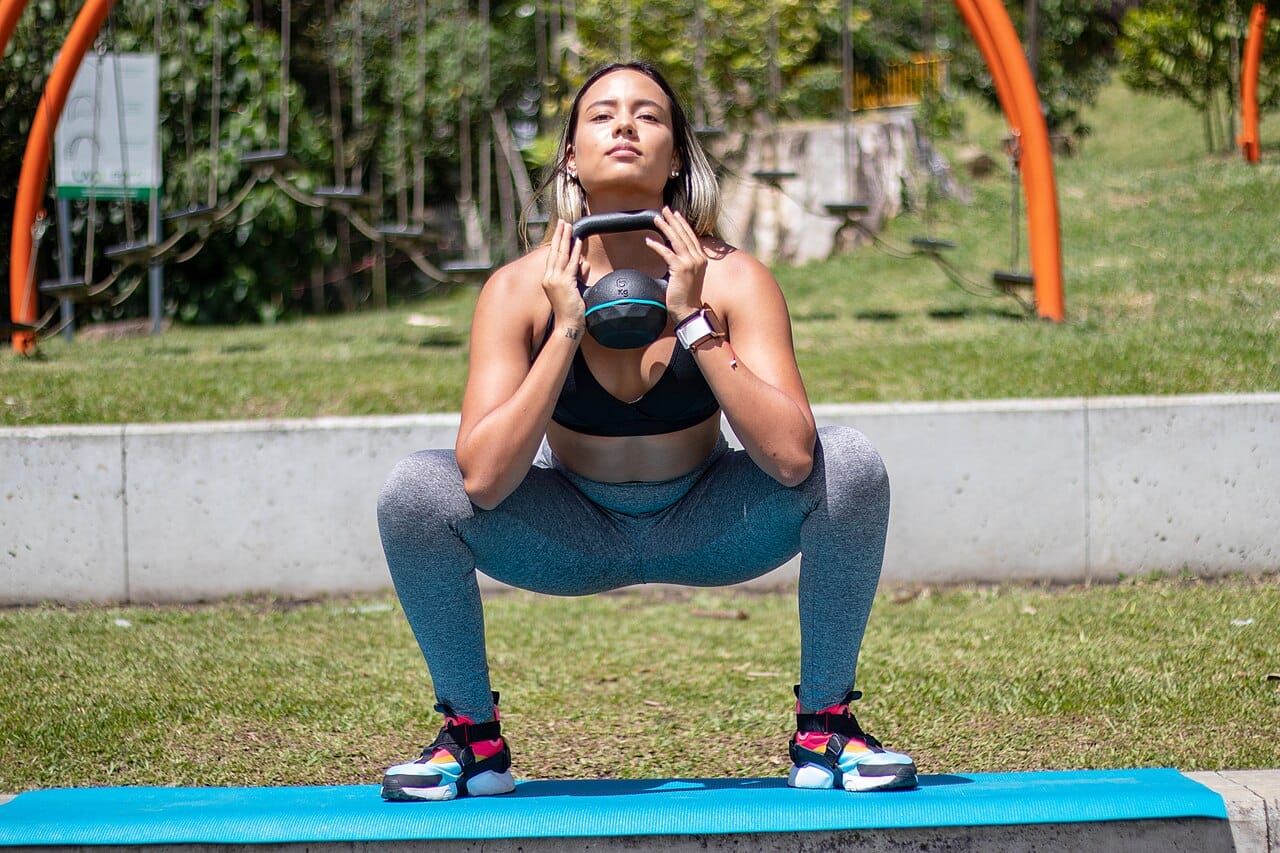
The choice between front squat and back squat usually gets framed as "which one is better." It's the wrong question. Both are legitimate, both belong in most training programs, and each trains different patterns that the other can't fully replicate. The real question is how to rotate or combine them to get the benefits of both.
I've run programs built around back squats exclusively and programs built around front squats exclusively. Both produce some results but leave real potential on the table. The rotation or combination approach has produced better squat numbers, better quad development, and better general strength for every lifter I've coached.
Back squat fundamentals
Bar sits on the upper traps (high-bar) or rear delts (low-bar). Torso angles forward to keep the bar over the mid-foot. The hip drives the movement; the quads handle the knee extension component.
High-bar back squat
Bar on upper trapezius, narrower stance, more vertical torso. Quad-dominant loading. This is the Olympic lifter's squat.
- Handles heavy loads (slightly less than low-bar but close)
- Builds strong quads and moderate posterior chain
- Requires good ankle mobility for depth
- Transfers directly to Olympic lifts and front squats
Low-bar back squat
Bar on rear delts, wider stance, more forward torso lean. Posterior-chain dominant loading. The powerlifter's squat.
- Handles the most raw load of any squat variation (5-10% more than high-bar for most trained lifters)
- Builds strong glutes, hamstrings, and lower back
- More forgiving of ankle mobility limitations
- Transfers to heavy deadlifting
Front squat fundamentals
Bar sits across the front deltoids, held by the elbows raised high ("rack position"). Torso stays upright throughout the lift. Quad-dominant with significant core and upper back engagement.
Load capacity: typically 70-80% of your back squat max. Not because the front squat muscles are weaker — because the loading pattern and the rack position cap the total load you can hold in position.
What front squats develop
- Quad strength and hypertrophy: the most quad-dominant of all squat variations
- Upright torso strength: upper back must stay rigid against the front load
- Core bracing: no forgiveness for soft abs — the bar dumps if bracing breaks
- Mobility: ankle, hip, and thoracic extension all get pushed to range
- Olympic lift transfer: direct carryover to cleans
Common issues
- Wrist flexibility: the rack position demands wrist extension many lifters haven't developed
- Elbow flare: if elbows drop, the bar rolls off the shoulders
- Thoracic tightness: can't maintain an upright torso without adequate thoracic mobility
- Core weakness: exposed immediately as a forward dump of the bar
When each one is appropriate
Back squat (high or low bar)
Appropriate when:
- Building maximum raw strength is the primary goal
- Training for powerlifting or general heavy squat numbers
- You already have adequate quad development and need to continue progressing load
- You have a specific powerlifting competition to peak for
Front squat
Appropriate when:
- Quad development is lagging
- Your back squat has a forward-lean problem that cues alone can't correct
- You're training for Olympic lifting or general athleticism
- Lower back fatigue is limiting your back squat frequency
- You want to develop core strength and bracing under load
Combining them in a program
Three approaches:
1. Rotate by block
8-week blocks alternating the primary squat:
- Block A (weeks 1-8): back squat primary (twice per week), front squat secondary (once per week)
- Block B (weeks 9-16): front squat primary (twice per week), back squat secondary (once per week)
- Rotate
This alternates the loading profile and prevents joint-wear issues from single-pattern overload.
2. Weekly integration
Both lifts each week, different days:
- Monday: back squat (heavy), 5 sets of 5
- Thursday: front squat (moderate), 4 sets of 5
The back squat is the primary strength work; the front squat serves as secondary volume with different loading emphasis.
3. Session integration
Both lifts in the same session:
- Back squat heavy: 4 sets of 5 at 85%
- Front squat back-off: 3 sets of 8 at 60% of back squat
Works for time-limited lifters who want both stimuli in one session.
The forward-lean problem
Many lifters develop a forward lean in their back squat over time. The torso angles more than it should, hip-rise becomes premature, and the squat loses its quad component. Back squat cues often don't fix this — the patterns are too ingrained.
Front squats fix it quickly. The front-load position physically forces an upright torso — you can't cheat it. Eight weeks of front squat emphasis often returns the back squat to proper positioning when it was drifting before.
The reverse problem
Lifters who only front squat sometimes develop a squat pattern too upright for their structure. When they return to back squat, they struggle with the more hip-dominant pattern. The fix is the same in reverse: include enough back squat work to maintain the pattern, even in a front-squat-dominant phase.
Equipment considerations
Front squats benefit from a dedicated barbell with chrome or coated sleeves — the bar rotates in the rack position and a sticky bar makes the position harder to hold. A 5-pound pair of lifting shoes with a raised heel helps for both front and back squats if you have ankle mobility issues.
For the front squat rack position, practice the empty-bar position daily. Many lifters need 2 to 3 weeks of daily drills to develop the wrist and elbow mobility for a comfortable front rack.
The cross-armed grip option
If wrist mobility makes the clean grip impossible for front squats, the cross-armed grip (arms crossed at the chest, bar resting on anterior delts, held with palms on opposite shoulders) is a legitimate alternative. It requires less wrist mobility but provides less stability for the bar.
For heavy loads above 80% of front squat max, the cross-armed grip becomes unreliable. For working sets in the 65-75% range, it's fine. Use it as a bridge while developing the clean grip.
Expected numbers
Front squat to back squat ratio typically lands:
- Beginner: 65-70%
- Intermediate: 72-78%
- Advanced: 78-85%
If your ratio is below 65%, front squat is likely lagging due to lack of programming. A 12-week front-squat emphasis block often raises this ratio by 5-10 percentage points.
The honest choice
You don't have to pick. Most intermediate and advanced lifters do best with both lifts in rotation across the year. The front squat fills gaps the back squat can't — specifically quad development and upright torso strength. The back squat handles the raw load the front squat can't accommodate.
Build both into your program. Rotate emphasis across blocks. Your squat numbers and overall leg development will exceed what any single-variation program produces.