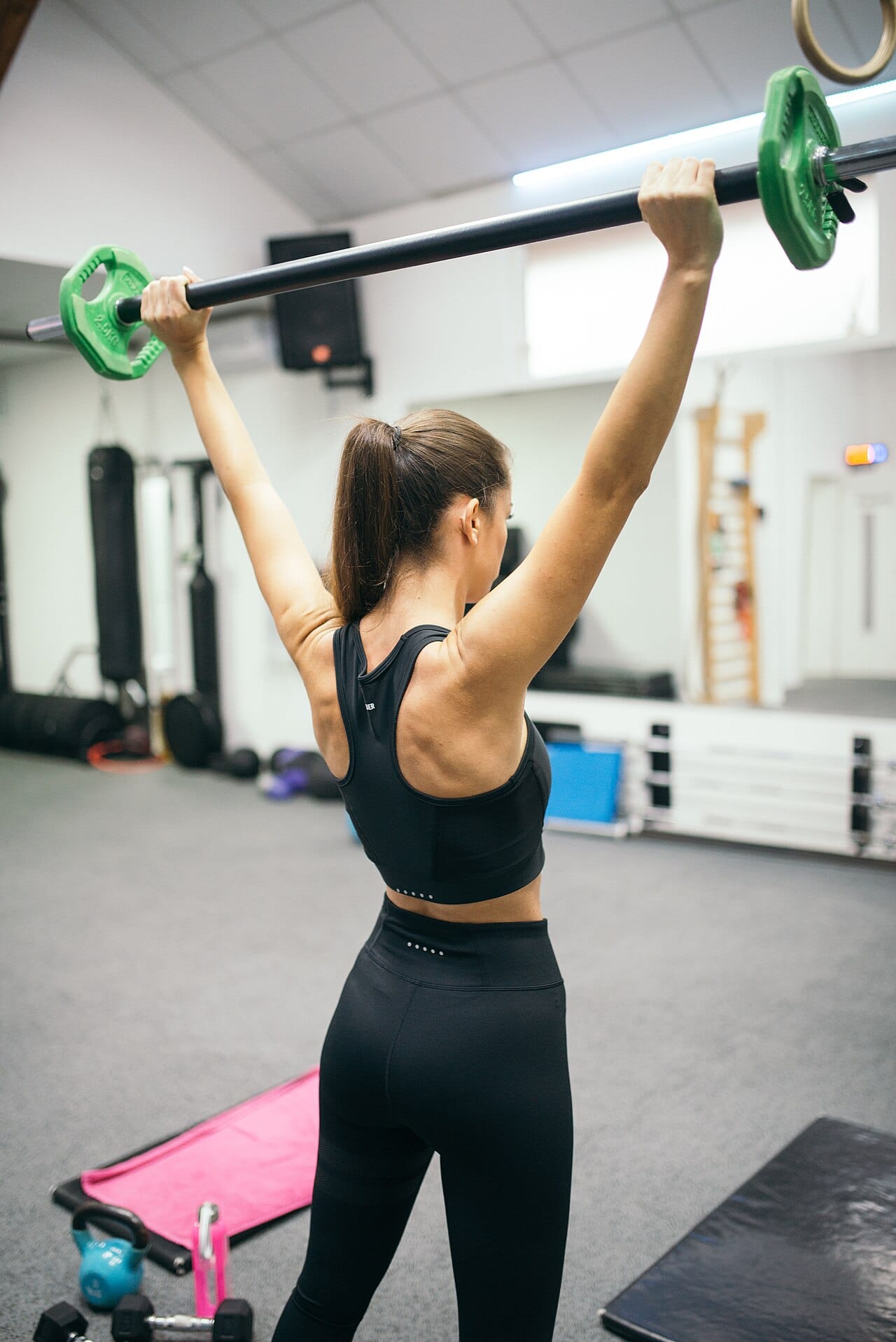
The overhead press is the honest lift in the gym. There's no bench holding your torso rigid, no machine dictating the bar path, no momentum assistance from a leg drive. You stand there with a weight over your head, held up by the strength and stability of your shoulder, core, and back. If any link in that chain is weak, the lift shows it immediately.
Most commercial-gym training has abandoned the overhead press in favor of the bench press. That's a mistake. The bench press develops pressing strength in one dimension. The overhead press develops pressing strength that actually shows up in real-world tasks — and it builds the stabilizing musculature that keeps shoulders healthy across decades of lifting.
Why it's "honest"
The overhead press doesn't let you cheat the way other pressing movements do. In the bench press, you have a bench supporting your back, a rack holding the bar, and leg drive you can borrow to finish grinding reps. In the overhead press, your own stability has to do all of it.
The specific weaknesses the overhead press exposes:
- Core bracing: if your core isn't locked, the bar drifts forward and you fail
- Upper back strength: if your rhomboids and rear delts can't pin your scapulae, your shoulder position collapses
- Shoulder mobility: if you can't get the bar over your head without arching the spine, mobility is the limiter
- Triceps strength: the top third of the press is mostly triceps — weak triceps fail the lockout
- Leg and glute stability: you're supporting the overhead load through a long lever arm; weak legs wobble
All of these show up immediately in the overhead press. Fix them through training, and your other lifts benefit too — the overhead press is diagnostic.
Standing vs seated
Standing (military press or strict overhead press) is the version I'm referring to. Seated overhead press and push press are different lifts with different demands.
- Standing strict press: no leg drive, strict elbow lockout, full core and hip engagement. The hardest and most diagnostic version.
- Seated barbell press: back supported by bench, removes core stabilization demand. Easier but less transferable.
- Push press: uses a knee dip and leg drive to initiate the press. Allows heavier loads, less shoulder strength specific.
- Seated dumbbell press: bilateral but allows more natural shoulder position. Good for hypertrophy, less for raw strength.
For a general strength lifter, the standing strict press is the primary variation. Use the others as accessories or variations, not replacements.
Technique fundamentals
The starting position
Bar racked at collarbone/upper chest height. Feet hip-width. Grip just outside shoulder-width. Elbows in front of the bar, not under it. Chest up, glutes tight, core braced.
The press
Drive the bar straight up. The key: move your head back slightly as the bar passes your face, so the bar travels in a vertical line rather than an arc. As the bar passes eye level, bring your head back through (push your head "through the window" as some coaches say) so the finished position has the bar directly over the shoulders and ears.
Lock out fully. Triceps engaged, scapulae slightly elevated and retracted at the top. Pause for a moment to control the finish.
The descent
Control the bar back to the starting position. Don't let it drop. The eccentric portion of the press trains the shoulder muscles at long ranges and is a significant portion of the hypertrophy benefit.
Common errors
- Hyperextending the lower back: using a back arch to press more weight. This shifts load onto the lumbar spine and away from the shoulders.
- Pressing the bar forward: the bar drifting in front of the shoulders at the top. This overloads the front delts and compromises the lockout.
- Not getting the head through: keeping the head back at the top instead of bringing it forward puts the bar behind your center of balance — unstable and weak.
- Soft core: if your abs relax during the press, the load has to be absorbed by the lumbar spine.
Expected strength
Benchmarks for bodyweight ratios on a strict overhead press (standing, no leg drive):
- 0.5x bodyweight: beginner capable
- 0.75x bodyweight: intermediate
- 1x bodyweight: advanced
- 1.25x+ bodyweight: elite recreational
A 180-pound lifter pressing 180 pounds overhead strictly is impressive — equivalent roughly to a 300-pound bench press in terms of developed pressing capacity.
Programming overhead press
The overhead press has a smaller recovery footprint than bench press. Most lifters can train it 1 to 2 times per week without accumulating fatigue issues.
Example programming:
- Primary overhead session: 4 sets of 5 at 80-85% max
- Secondary session (optional): 3 sets of 8 at 65-70% max for hypertrophy
For a 4-day split, pair overhead press with pulling work on one day and with chest work on another:
- Day 1: squat + bench
- Day 2: deadlift + rows
- Day 3: front squat + overhead press
- Day 4: light bench + pulling accessories
Accessory work that helps
Four movements that support the overhead press:
- Push press: allows heavier overload of the top portion of the press, trains lockout
- Standing barbell shrug: upper trap strength supports the top position
- Seated dumbbell press: builds shoulder mass without the stability limitation
- Bent-over rear delt fly: rear delt strength for shoulder stability and scapular control
Overhead press for shoulder health
The bench press trains one shoulder function — horizontal adduction. The overhead press trains another — shoulder flexion to overhead. Running only bench press creates imbalanced shoulder development that predisposes to impingement and chronic anterior tightness.
Including the overhead press in your program maintains shoulder mobility, builds the stabilizing musculature that supports bench press performance, and reduces long-term shoulder injury risk. This is why serious lifters across all decades have included it as a main lift.
The caveat for shoulder pain
If you have active shoulder pain in the overhead position, don't power through. Reduce range of motion, use dumbbells instead of barbell, or temporarily replace with landmine press until the pain resolves. The overhead press is valuable long-term, not worth aggravating an injury to include in a specific session.
The dumbbell press alternative
For lifters with specific shoulder mobility issues that make the barbell overhead press uncomfortable, seated dumbbell press is a legitimate substitute. The dumbbells allow a natural rotation through the movement that the barbell locks you out of.
The tradeoff: less total load, less core stabilization training, less transferable to deadlift and squat bracing patterns. But if shoulder mobility is the limiter, dumbbells produce the same hypertrophy stimulus without the discomfort.
The long-term benefit
Lifters who include the overhead press through their 40s and 50s tend to maintain shoulder function better than lifters who abandoned it for bench-only programs. The bench-only cohort often shows up with chronic shoulder issues by 45. The overhead press cohort more often still moves freely overhead at 55.
Programming the overhead press is shoulder insurance. Skip it and you're saving short-term recovery budget at the cost of long-term joint health.
Get it in your program
If you're not currently overhead pressing, add it as a once-weekly main lift. Commit to 12 weeks of consistent programming. Expect your numbers to be humble — overhead press numbers are typically 60-70 percent of bench press numbers for trained lifters, not the 80-90 percent some beginners expect.
Run it at 80-85 percent intensity, 4-5 sets of 5 reps, add small weekly or biweekly increments. Watch the carryover to your bench, squat (core stability), and overall shoulder health over the training block.