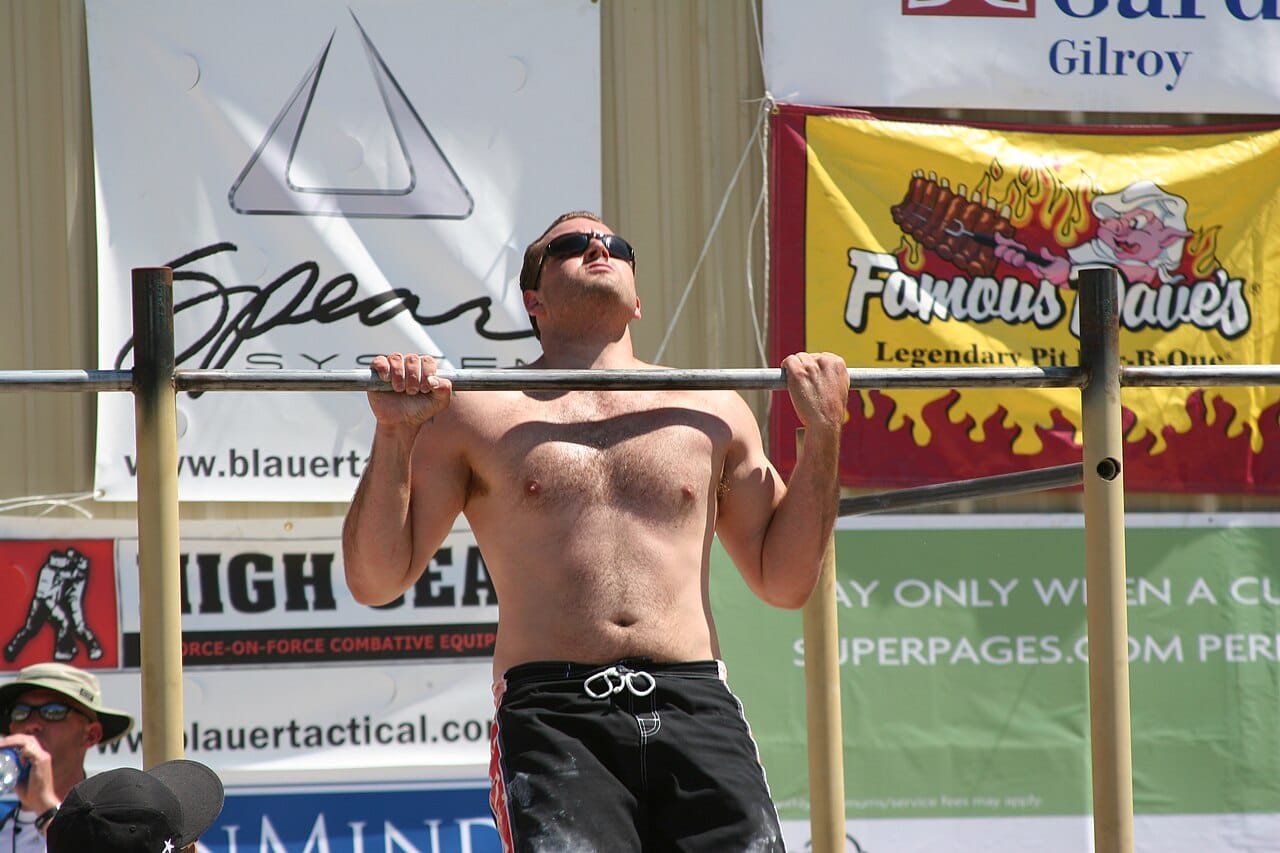
The pull-up is still the single best vertical-pull exercise available, and it's consistently undertrained. Most lifters treat pull-ups as an optional back finisher rather than a primary compound lift. That's a mistake. Weighted pull-ups build more raw upper back mass, grip strength, and functional pulling capacity than any lat pulldown variation, and they scale all the way from beginner bodyweight work to serious advanced lifter territory at 100+ pounds of added weight.
If your pull-up numbers haven't been climbing for a year, you're missing one of the biggest levers in upper body development. A lifter who can pull 15 weighted pull-ups with 60 pounds added looks — and is — stronger than a lifter who can pulldown 250 pounds for the same rep count.
Pull-up vs pulldown: the real comparison
Lat pulldowns and pull-ups are similar movements but not equivalent exercises. Pull-ups involve:
- The entire body hanging from the bar (full grip and shoulder load throughout)
- Core stabilization to prevent swing
- Scapular and upper trap engagement through full ROM
- Full body weight as the resistance baseline
Lat pulldowns involve:
- Seated position with thigh pads (stabilization handled externally)
- Partial body weight (the machine supports some of it)
- Controlled load via a weight stack
- Less grip demand at equivalent perceived effort
The pulldown is useful — particularly for lifters who can't yet do pull-ups or for accumulating high-volume work. But the pull-up transfers more completely to functional strength and general upper body capability. 12 weighted pull-ups with 50 pounds added is a better index of upper body strength than almost any other single-movement standard.
Grip variations
Three main pull-up grips, each training slightly different emphasis:
Pull-up (pronated, palms forward)
The classic. Hands overhand, grip about shoulder-width or slightly wider. Targets the lats, middle back, and biceps (brachialis specifically).
Hardest of the three variations for most lifters. The overhand grip limits biceps contribution, placing more emphasis on the back.
Chin-up (supinated, palms toward you)
Hands underhand, shoulder-width. Targets the lats and biceps (biceps brachii significantly more than pull-ups).
Easier than pull-ups by 10 to 15 percent for most lifters. Biceps carry more load. Good for hypertrophy and for lifters progressing toward weighted pull-ups.
Neutral grip (palms facing each other)
Hands facing each other on parallel grip handles. Targets the lats with a shoulder-friendly position.
Often the easiest variation and the most shoulder-forgiving. Good option for lifters with shoulder sensitivity on pronated pulls.
Progression path
For lifters who can't yet do bodyweight pull-ups:
- Lat pulldowns: build base strength in the pulling pattern. Work up to 1.5x bodyweight for 8 reps.
- Band-assisted pull-ups: loop a resistance band from the pull-up bar under your feet. The band provides less assistance at the top than the bottom (matching the strength curve). Graduate from heavy bands (50+ lb assistance) to light bands.
- Negative pull-ups: jump to the top position, lower yourself under control as slowly as possible. 5-second lowering, 3 to 5 reps per set.
- Bodyweight pull-ups: work up to 8-10 reps with clean form
- Weighted pull-ups: add weight via belt or vest, starting at 10-25 pounds
Most men can progress from zero pull-ups to 8 bodyweight reps in 12 to 24 weeks of consistent programming. Going from 8 bodyweight to 5 weighted pull-ups with 25 pounds added typically takes another 8 to 12 weeks.
Weighted pull-up benchmarks
Relative to bodyweight, for reps:
- Beginner: bodyweight for 3-5 clean reps
- Intermediate: bodyweight + 25 lbs for 5 reps, or bodyweight for 10 reps
- Advanced: bodyweight + 45 lbs for 5 reps, or bodyweight + 25 lbs for 10 reps
- Elite recreational: bodyweight + 90+ lbs for 5 reps
At the advanced-to-elite level, you're doing the equivalent of pulling your body plus a full plate overhead 5 times. Few exercises display upper body strength as cleanly.
Programming pull-ups
Program weighted pull-ups as a primary compound lift, not as an afterthought. Treat them with the same seriousness as bench press or barbell row.
Strength-focused
4 sets of 3 to 5 reps at RPE 7-8 with weight that challenges. Once per week. Add 2.5 to 5 pounds to the belt each week until the rep target fails.
Volume/hypertrophy-focused
4 sets of 6 to 10 reps at RPE 8-9. Add weight more slowly (5 pounds every 2 to 3 weeks). Alternatively, use bodyweight-only and focus on total weekly rep count.
Frequency
Once per week is fine for most intermediate lifters. Twice per week (heavy pull-up day plus volume pull-up day) works for intermediate-to-advanced lifters and typically produces faster progress.
Equipment
Needed: a stable pull-up bar rated for at least 250 pounds with your added weight. Doorframe bars are acceptable for bodyweight work; they're not safe for weighted pull-ups. Buy a wall-mounted bar or a pull-up bar on a power rack.
For weight: a dipping belt with a chain and carabiner is the standard. Weight vests work but cap around 50-60 pounds and are less balanced than plate-on-chain setups.
Form considerations
Key points:
- Start from a dead hang: chest down, scapulae released at the bottom. Each rep starts from this position.
- Pull chest toward the bar: not just chin over. The top position has the chest near the bar, back arched.
- Engage lats, not just biceps: think about pulling the elbows down and back rather than bending the elbows. This shifts work to the back.
- Control the descent: lower under control, don't drop. The eccentric is half the training stimulus.
- No kipping: CrossFit-style kipping is a different movement and doesn't train the same musculature. Strict pull-ups only for strength development.
Common problems
Kipping or swinging
If you can't do a strict rep without using momentum, you need to work on bodyweight strength before adding weight. A clean bodyweight pull-up is the foundation.
Elbow pain
Usually indicates excessive volume, poor shoulder position, or insufficient warm-up. Reduce frequency, improve warm-up (scapular pull-ups, band pull-aparts), and check that you're not hyperextending at the bottom of each rep.
Can't reach full ROM
At the bottom, arms should fully extend. If you're stopping short, you're not training the lats through full range. Accept lower rep counts with full ROM rather than higher rep counts with partial ROM.
Pull-ups for bodyweight loss
Every pound you lose is a pound less you have to pull up. Pull-ups are one of the few exercises where bodyweight loss directly produces better-looking numbers without any training improvement.
A 200-pound lifter doing 8 bodyweight pull-ups who cuts to 175 pounds often can do 12 to 14 bodyweight pull-ups at the lower weight, even with similar absolute strength. The relative strength improvement is real and visible.
The long view
Pull-ups are one of the few movements that scale across your entire lifting career. Beginners work up to them. Intermediate lifters add weight. Advanced lifters pull with significant weight added for reps. Elite recreational lifters hit plus-100-pound territory.
Commit to pull-up progression. Treat them as a main lift, not an accessory. Your upper back development and overall pulling strength both benefit more than from any alternative.