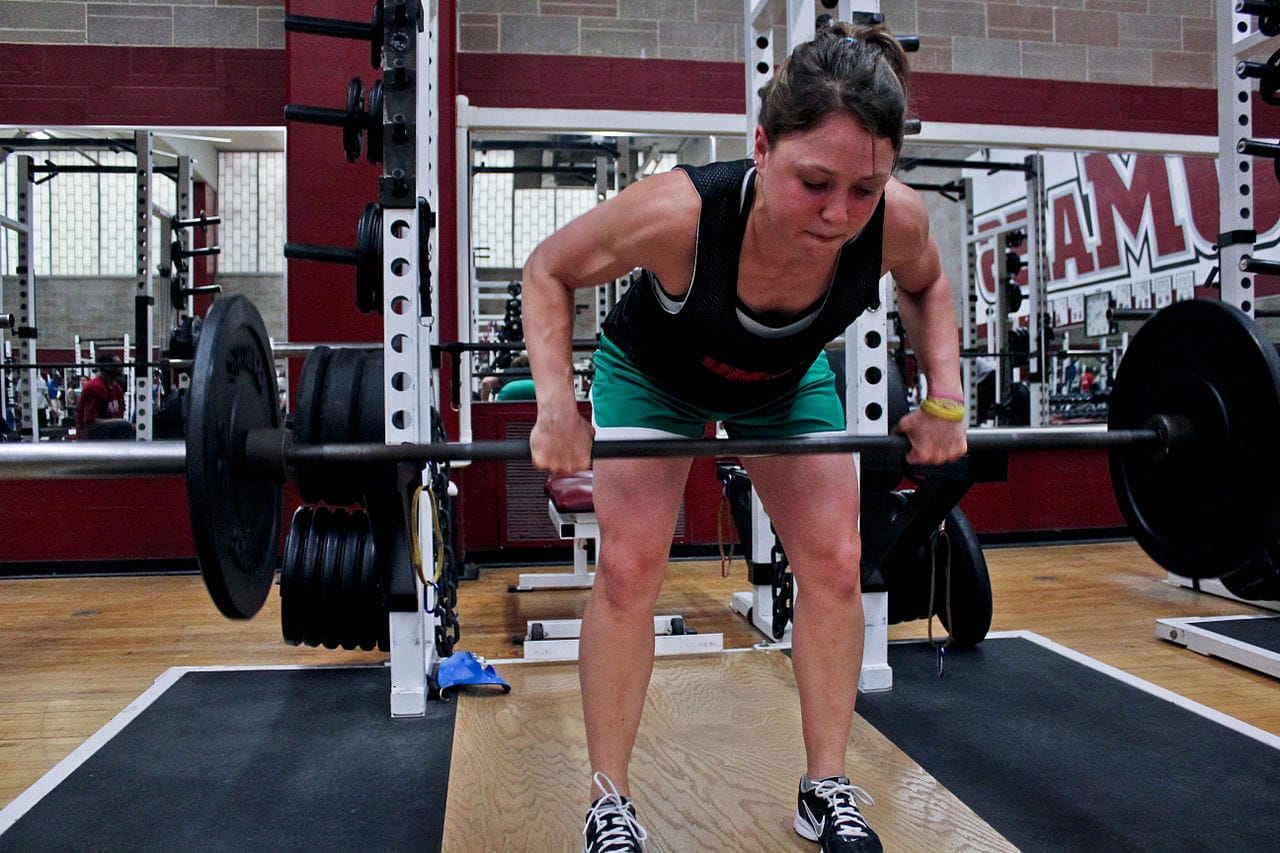
Rowing movements are supposedly interchangeable. Anyone running a general hypertrophy program hits rows on back day and doesn't think much about which variation. But barbell rows, dumbbell rows, and cable rows load the back differently enough that choosing the right one for a given situation — or including all three in rotation — matters more than the default gym wisdom suggests.
Programmed correctly, each variation fills a specific gap the others can't. Most intermediate lifters' back training benefits from having all three in rotation across training blocks, not from picking a single favorite and running it year-round.
Barbell row
The classic. Bent-over row with a barbell. Hip hinge position, torso parallel to floor or slightly above, bar pulled to the lower chest/upper abdomen.
Strengths
- Handles the most absolute load of any row variation (commonly 75-90% of bench press for trained lifters)
- Forces core and lumbar stabilization under heavy load
- Builds significant upper back thickness and density
- Compound pattern carries over to deadlift and squat (torso bracing)
Weaknesses
- Lumbar fatigue — heavy barbell rows are expensive for lower back recovery
- Form breakdown at higher reps — the bent-over position is hard to maintain under fatigue
- Limited range of motion at the bottom (can't pull as low as with a bench-supported option)
- Grip and bar path issues — any imbalance shows immediately
Programming
3 to 4 sets of 5 to 8 reps at 65-75% of deadlift max. Once per week. Best programmed on a lower back recovery day — not the day after or before heavy deadlifts.
Dumbbell row (one-arm, bench-supported)
Knee and opposite hand on a bench, dumbbell pulled from directly below to the ribcage. Unilateral — one arm at a time.
Strengths
- Eliminates lumbar stabilization as a limiter (the bench supports the torso)
- Full range of motion — pull deeper than any barbell variation allows
- Exposes and fixes side-to-side strength asymmetries
- Lower recovery cost than barbell rows
- Can pull heavier per arm than equivalent barbell row weight would suggest
Weaknesses
- Takes twice as long per set (one arm at a time)
- Less total core stabilization training than the unsupported barbell variation
- Limited by dumbbell availability — most commercial gyms cap around 100-125 pounds
- Can be cheated with hip rotation — strict form is essential
Programming
3 to 4 sets of 8 to 12 reps per arm at whatever weight allows strict form. Rest less between sides than between sets (20 seconds between arms, 90 seconds between sets).
Cable row (seated)
Cable station with a V-handle or wide-grip handle. Seated or chest-supported. Pull handle to lower chest or upper abdomen, returning under control.
Strengths
- Constant tension throughout the range of motion (cable tension doesn't vary with lever angle)
- Joint-friendly — the cable accommodates your arc rather than forcing a specific path
- Easier to target specific back regions by changing handle and angle
- Zero lumbar stress (fully supported position)
- Fatigue-resistant — can train high reps without form breakdown
Weaknesses
- Less raw load ceiling than barbell rows
- Doesn't train core stabilization (fully supported)
- Requires access to a cable station (not all home gyms have this)
- Can feel less "serious" than free-weight options — easy to go soft on effort
Programming
3 to 4 sets of 10 to 15 reps. Excellent for higher-rep hypertrophy work, drop sets, and fatigue-accumulation training. Usually placed later in the session after heavier compound work.
Which one to pick when
Training for strength: barbell row as primary. The absolute load capacity supports the highest strength stimulus.
Training for hypertrophy in a volume phase: dumbbell row plus cable row. The combination trains a wider range of motion with lower recovery cost.
Recovering from a back injury: cable row first, then dumbbell row, then barbell row as you progress.
Fixing a lagging side (asymmetry): dumbbell row. The unilateral nature exposes and addresses side-to-side imbalance better than bilateral lifts.
Adding volume without stressing lumbar: dumbbell or cable row. Barbell row requires lumbar bracing that accumulates fatigue.
Running all three in a program
A 4-day split program might include:
- Monday (heavy upper): barbell row, 4 sets of 5 at 80%
- Thursday (hypertrophy upper): dumbbell row, 4 sets of 10 per arm
- Saturday (accessory): cable row, 3 sets of 12-15
Weekly total: 11 working sets of rowing, hitting different muscle recruitment patterns and loading profiles. This is more productive for most lifters than 11 sets of one row variation.
The frequency consideration
The back responds well to high training frequency — 3 back sessions per week is supportable for most intermediate lifters. Using different row variations on different days allows the frequency without repetitive stress on any single pattern.
Doing barbell rows 3 times a week would be excessive for lumbar recovery. Doing barbell rows once, dumbbell rows once, and cable rows once per week is easily recoverable and produces better total back development.
Supporting movements
Rows are compound pulls. Full back development also requires:
- Vertical pulls: pull-ups or lat pulldowns for lat width
- Face pulls: rear delt and trapezius work, shoulder health
- Rear delt flies: isolated rear delt work
A complete back day includes at least one horizontal pull (row) and one vertical pull (pulldown or pull-up). Weekly back volume for trained lifters lands around 14 to 20 total working sets across all pulling exercises.
Common mistakes across all variations
Three errors that show up in all row variations:
1. Momentum
Using body English or hip swing to move weight you can't control. If you're whipping the weight up with hip motion, the weight is too heavy — reduce the load and control the rep.
2. Incomplete range of motion
Stopping short at the top. The full row pulls the weight all the way to the body (or as close as the angle allows). Shorter pulls reduce the stretch on the lats and miss the peak contraction.
3. Shrugging instead of retracting
Using upper trap dominance to pull the weight up rather than using scapular retraction. Your shoulders should pull back (retract), not up (shrug). If you feel the trap doing most of the work, your pattern is wrong.
The handle grip question
For cable rows, handle choice changes the emphasis:
- V-handle (neutral grip): generally balanced back engagement
- Wide grip: more lat emphasis, less mid-back
- Close grip: more mid-back and rhomboid emphasis
- Single-arm handle: allows deep range of motion and addresses asymmetry
Rotate handles across training blocks for varied stimulus.
Bottom line
Don't pick one row and run it forever. Rotate all three variations across training blocks or weeks. Each one addresses a different aspect of back development, and the lifters with the best-developed backs typically use all three.
Program barbell row for strength, dumbbell row for range and asymmetry correction, cable row for volume and constant-tension work. The three together outperform any single variation run in isolation.