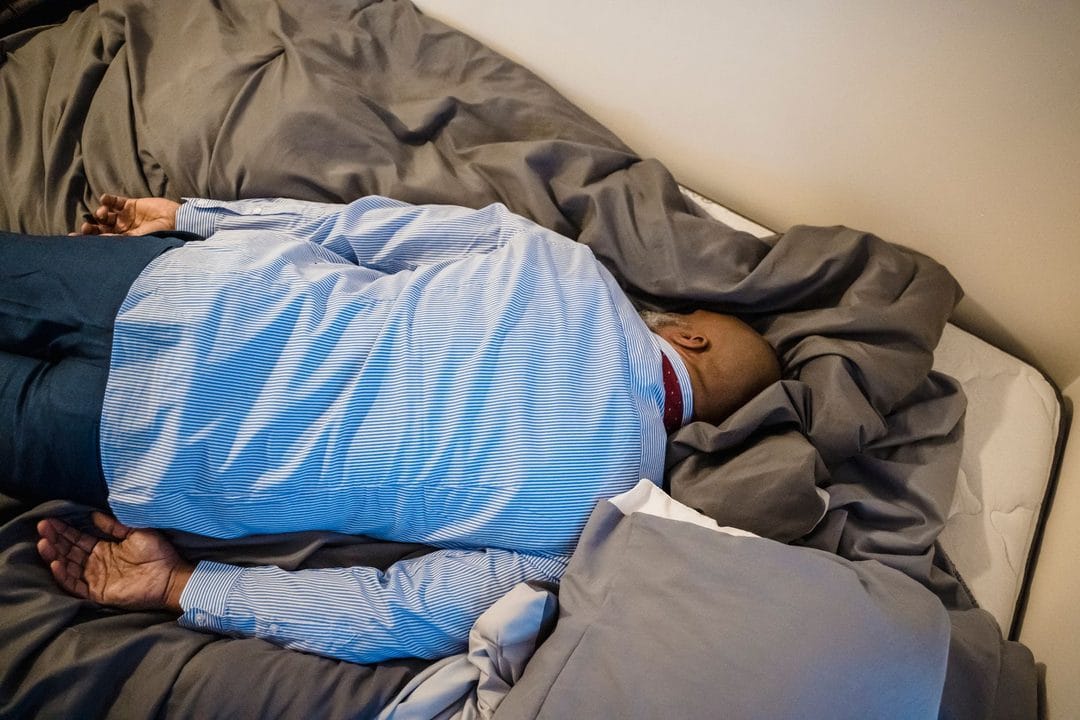
The Set You Did in the Gym Isn't Where the Muscle Gets Built
You hit a rep PR on your last set of squats, foam-rolled for ten minutes, choked down forty grams of whey, and then stayed up until 1 a.m. because a show was good. Six hours later the alarm went off for work, and you told yourself it was fine because the workout itself had gone well. Nothing about that Tuesday looks like a training mistake on paper — no missed sets, no skipped protein, no shortcut on form, nothing you'd flag in a log. But it was a mistake, and it's the one that quietly decides how much of that squat session actually turns into muscle instead of just fatigue you walked off with. Most guys will spend forty dollars chasing a marginally better pre-workout before they'll touch their bedtime, and that's exactly backwards.
Training breaks tissue down. Sleep is where the rebuilding happens — the actual protein synthesis, the hormone release, the nervous system recovery that lets you load the bar heavier next week. Skip the training and nothing happens. Skip the sleep and the training you already did partially goes to waste, because the repair window that turns a workout into growth never gets the time it needs to run.
What Five Hours a Night Does to Testosterone
Testosterone follows a sleep-dependent rhythm — levels rise through the night and peak during the REM-heavy stretches in the second half of a normal sleep cycle, then decline through the day from that morning high. Cut the night short and you cut off the part of the cycle where the hormone actually accumulates, not just an arbitrary hour at the end. Men who chronically sleep five to six hours a night show measurably lower morning testosterone than men getting seven to nine, and the drop shows up within about a week of restriction — this isn't a slow-burn effect that takes months to appear, it's fast, and it's the kind of thing a blood panel would catch after one bad training block.
Lower testosterone doesn't just blunt strength gains. It shifts the whole recovery equation toward fat storage and away from lean tissue, which is exactly the direction nobody training four days a week is trying to go.
Growth Hormone Doesn't Wait for a Convenient Bedtime
A large share of daily growth hormone release happens during slow-wave sleep — the deep, hard-to-wake-from stage concentrated in the first two or three sleep cycles of the night. Push bedtime back from 10:30 to 1 a.m. without changing your wake time and you're not just losing hours off the total. You're disproportionately cutting into the exact window where GH release is heaviest, front-loaded early in the night before the lighter, more fragmented stages take over toward morning.
This is the part most lifters miss entirely.
They track sleep duration on a ring or a watch and ignore sleep timing, when timing is doing at least half the work. A six-hour night that starts at 11 costs you less recovery than a six-hour night that starts at 2 a.m., even though the total on the app looks identical.
Cortisol, Hunger, and the 9 p.m. Binge You Can't Explain
Sleep restriction pushes cortisol up and scrambles the two hormones that govern appetite — ghrelin rises, leptin drops, and the net effect is a brain that reads "tired" as "hungry" even when the body doesn't actually need the calories. That's why a bad sleep week so often comes with a fridge raid that has nothing to do with real hunger and everything to do with a stress hormone doing its job badly. Guys cutting calories on four or five hours of sleep report hunger levels that don't match their intake at all, and it isn't willpower failing — it's the biology working exactly as designed against the wrong input.
There's a nuance worth sitting with here: a small number of people carry a genetic variant that lets them function on six hours without measurable hormonal disruption — the so-called short-sleeper mutation. The problem is that almost everyone who tells himself he's one of those people is wrong. The gene is genuinely rare. The self-diagnosis is extremely common, and it's usually just tolerance to feeling bad, not immunity to the underlying damage.
Why This Costs More After 30
Baseline testosterone and growth hormone output both decline gradually with age, starting well before most guys notice any performance drop. Layer chronic sleep debt on top of that natural decline and the two effects compound instead of just adding up — a 35-year-old lifting on five hours of sleep isn't losing what a 22-year-old would lose on the same schedule, he's losing more, because he's starting from a lower hormonal baseline to begin with. This is the single biggest reason guys in their late thirties feel like their recovery "just isn't what it used to be" despite training smarter and eating better than they did a decade earlier. It's rarely the program. It's almost always the sleep.
Tracking It Without Turning Sleep Into Another Job
You don't need a sleep lab to get useful data. An Oura Ring or a WHOOP strap will give you resting heart rate, heart rate variability, and rough sleep-stage breakdowns that are good enough to spot a pattern — not medical-grade, but consistent enough to show you when your HRV is tanking three days after a run of short nights. The Eight Sleep Pod goes further by actively cooling the mattress through the night, and that matters more than people expect: core body temperature has to drop for deep sleep to kick in, and a hot bedroom in July is a legitimate training variable, not just a comfort complaint.
- Keep the bedroom around 65–68°F if you can control it
- Get morning daylight within 30 minutes of waking — it anchors the cortisol curve that governs when melatonin releases that night, and this one habit alone fixes more sleep problems than any supplement on the shelf
- Cut caffeine by early afternoon; the half-life is longer than most people assume, and a 3 p.m. coffee is still doing something to you at 10 p.m.
- Alcohol fragments sleep architecture even when it knocks you out fast — a nightcap is not a sleep aid, whatever it feels like in the moment
The Fix Isn't a Supplement
Magnesium glycinate and apigenin show up in every recovery-stack recommendation, and there's a reasonable case for both — but no supplement replaces a bedtime that gives you a genuine seven-and-a-half to eight hours of opportunity to sleep. Fix the schedule first. If you're already hitting bed on time and still waking up wrecked, then start layering in the extras. Most guys skip straight to the pill and skip the actual behavior change, which is backwards, and, frankly, the easier path precisely because it's the one that doesn't require moving bedtime up by ninety minutes.
Treat sleep like you treat the bar: non-negotiable, tracked, and progressively protected. The lifters who look like they recover faster than everyone else in the gym aren't running a better stack. They're just going to bed on time, and they've been doing it long enough that it stopped looking like discipline and started looking like talent.
The Protein Timing Question Sleep Actually Answers
Guys obsess over the thirty-minute anabolic window after training and then ignore the eight-hour window that follows it at night, which is backwards given how much repair work actually happens during sleep rather than in the hour right after a workout. A slow-digesting protein source before bed -- casein, cottage cheese, or a scoop of micellar casein powder -- gives the body a steady amino acid supply through the exact stretch of the night when slow-wave sleep is doing the heaviest repair work. Skip that pre-bed protein and train on five hours of sleep at the same time, and you've stacked two separate recovery deficits on top of each other rather than just one.
None of this replaces the sleep itself. It just stops the sleep you do get from being wasted on an empty tank.