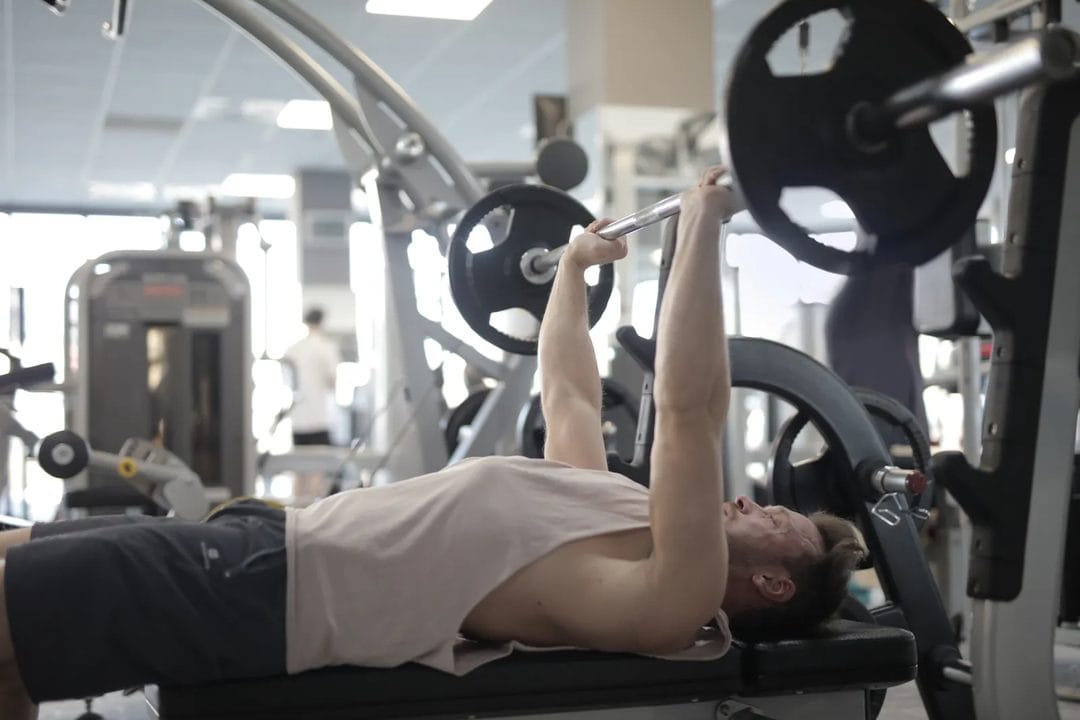
Set the bar down after a working set of bench and ask most men over 35 how their shoulder feels, and you'll get a wince before you get an answer. Not from the weight — from the joint. The bench press hasn't changed in a hundred years, but the way most lifters were taught to do it is quietly working against their shoulders, and nobody flags it until the joint starts complaining on a schedule of its own.
The Setup Nobody Actually Checks
Walk into any commercial gym and watch ten men bench press. Most of them lie down, grab the bar at roughly shoulder width because that's where their hands landed, plant their feet somewhere under the bench for balance, and press. Nobody taught them a setup because nobody thought one was needed — you lie down, you push a bar, what's to teach? That assumption is exactly why so many men in their late 30s and 40s end up nursing a shoulder that clicks on the way up and burns on the way down, usually after a decade of otherwise sensible training.
The fix isn't complicated, but it does mean unlearning a habit that's been automatic for years. A proper bench setup starts on your back before the bar ever leaves the rack: shoulder blades pulled down and together, chest lifted into the bar, feet planted flat and slightly behind your knees so you can actually drive through the floor. This isn't a powerlifting stunt reserved for competition platforms — it's the position that keeps the load off the front of your shoulder and puts it where your chest and triceps can actually handle it. Skip it and you're benching off your shoulder capsule instead of your pecs, which works fine for a few years and then, quite suddenly, doesn't.
How Much Arch Is Enough
You don't need the extreme lumbar arch you see in raw powerlifting meets — that's a technique built for moving maximal weight through the shortest legal bar path, not for a general strength program. What you need is thoracic extension: chest up, shoulder blades retracted and pinned to the bench, a natural arch in your lower back rather than a flattened one. Lie down and try pressing your lower back flat against the bench — that's the position to avoid. It rounds your upper back, lets your shoulders roll forward, and turns every rep into shoulder flexion instead of a chest press.
Grip Width Isn't One-Size-Fits-All
Most men bench with a grip that's wrong for their own shoulders, borrowed from whoever they trained with first.
Standard Olympic barbells have knurl rings marked 81cm apart, center to center, and most lifters default to gripping just outside them because that's what looks like a "normal" bench grip. For a lot of men, that's too wide. The common coaching heuristic — grip roughly 1.5 to 2 times your biacromial width, meaning the distance across your shoulders — puts most men somewhere between 61 and 71cm hand-to-hand, noticeably inside those rings.
Go too wide and you shorten the range of motion, which feels like an advantage for loading plates, but it also drives your upper arm into a more extreme horizontal position relative to your torso at the bottom of the lift. That's the exact position that stresses the front of the shoulder joint. Go too narrow and you shift the work onto your triceps and lose chest engagement, which isn't dangerous but defeats the point of the lift. Test three grip widths across a few sessions — two knuckles inside the rings, at the rings, and two knuckles outside — and pay attention to which one lets you touch your chest without your elbows flaring past 75 degrees from your torso. That's your grip, regardless of what looks standard on someone else's Instagram.
The Shoulder Health Angle
Bench press doesn't have to be hard on shoulders. It becomes hard on shoulders when the bar path drifts, the elbows flare wide, and the setup collapses under fatigue on the last two reps of a set — which is exactly when technique degrades and exactly when most injuries happen. Elbow flare is the single biggest culprit. Letting your elbows splay out to 90 degrees from your torso at the bottom of the rep puts your rotator cuff and the front of your shoulder capsule into a compromised position, especially under load.
Tuck the elbows to somewhere between 45 and 75 degrees instead, and the bar path naturally becomes a slight diagonal — down toward your lower chest, up and slightly back toward your face — rather than a straight vertical line. That diagonal path is not a flaw. It's actually the mechanically efficient one, and it's the same path you'll see from any competent powerlifting coach or a strength coach like the ones at Westside Barbell teaching a controlled bench technique. If your shoulder pinches specifically at the bottom of the rep, that's often the elbow-flare problem showing up before it becomes a bigger issue.
There's a nuance worth naming here: not every shoulder twinge means bad technique. Some men have genuinely limited shoulder mobility from old injuries, years of desk work, or simply how their joints are built, and no amount of setup coaching will make a heavy flat bench comfortable for them. For those lifters, a slight incline — even 15 to 30 degrees — or dumbbells instead of a fixed barbell often solves in one session what months of cueing never will. Chasing the "correct" flat barbell bench at the expense of a joint that clearly doesn't like it isn't discipline, it's just stubbornness with a spreadsheet.
Programming for Men Over 35
Twice a week is the sweet spot for most lifters in this age bracket — enough frequency to build the skill and the strength without accumulating the joint fatigue that comes from benching heavy three or four times a week. One session in the 5–8 rep range at a genuinely challenging weight, and a second session either lighter for higher reps (10–15) or swapped for a close-grip or incline variation that hits the same muscles from a different angle and gives your shoulder joint a break from the exact same stress pattern.
Warm up properly before you touch a working set — not just the bar for a few reps, but a real progression: bar, then roughly 40%, 60%, 80% of your working weight for singles or doubles, band pull-aparts and face pulls worked in between sets to keep the rear delts and rotator cuff firing. Skipping this because you're short on time is one of the more common ways a healthy shoulder becomes an unhealthy one over a training cycle, and it costs you five minutes you'll happily trade for six more months of pain-free pressing.
- Session A: flat barbell bench, 4 sets of 5–8 reps, 2–3 minutes rest
- Session B: incline dumbbell press or close-grip bench, 3–4 sets of 10–15 reps
- Accessory work both days: face pulls, band pull-aparts, and at least one horizontal row for every pressing set — a 1:1 push-pull ratio keeps the shoulder balanced front to back
What to Actually Change This Week
Don't overhaul everything at once. Pick one variable — the setup arch, the grip width, or the elbow angle — and spend two full sessions on just that before adding the next. Trying to fix your arch, grip, and bar path simultaneously usually means you fix none of them properly, because your brain can only hold one new cue under a loaded bar before old habits take over.
If your shoulder has already been bothering you for more than a couple of weeks, drop the weight by 20–30% and rebuild the pattern before you rebuild the load. A lighter bar with a clean setup does more for your long-term bench numbers than another month of grinding through pain on autopilot — and it's a lot cheaper than the physiotherapy session you'll eventually book if you don't.