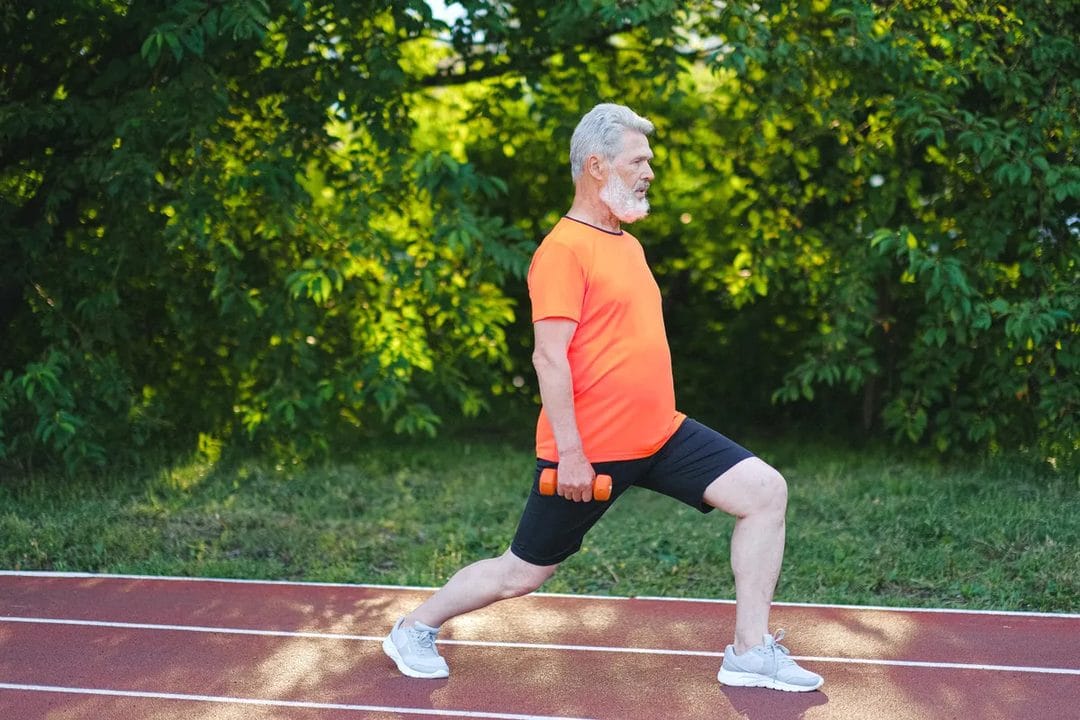
Set up for a heavy back squat and film yourself from behind, then watch the bar path on the concentric. Most men over 35 who've been squatting for a decade will see something they don't want to see: the bar drifts an inch to one side, one knee tracks slightly inward, and the hips shift a hair before lockout. Nobody taught them to do that. Their stronger leg has been quietly bailing out the weaker one for years, and the bilateral lift never once told on it.
That's the core problem with squats, deadlifts, and leg presses as a complete lower-body program. They're excellent for loading heavy and building raw strength, but two legs working together will always let the dominant side compensate for the lagging one. A barbell doesn't care which leg is doing the work, only that the total force adds up. Single-leg training removes that safety net. When one leg has to do everything on its own — no borrowing, no shifting, no cheating the rep — the weak side either does its job or the set falls apart in front of you.
The Compensation You Can't See From the Front
Most strength imbalances between legs don't show up as pain. They show up as a slow leak in your numbers. A lifter stalls on his squat at 315 for months, adds a mobility drill, tweaks his stance width, and still can't move the needle — meanwhile his left glute has been doing roughly 55-60% of the work on every rep because his right hip has never fired properly since a college ankle sprain. The squat can't diagnose that. It just gets harder.
Bulgarian split squats, reverse lunges, step-ups, and single-leg RDLs expose this immediately, usually within the first set. Load a Bulgarian split squat with a pair of 40-pound dumbbells and you'll know inside of five reps whether your right leg can actually match your left, because there's no bar to spread the load across two limbs. Rogue Fitness sells a flat 12-inch plyo box for around $180 that works fine for step-ups and rear-foot-elevated setups — you don't need anything fancier than a sturdy bench at home. What you need is the honesty the exercise forces on you.
What Actually Counts as Unilateral Work
Not every single-leg movement carries the same training effect, and lumping them together is where a lot of programming goes wrong. Bulgarian split squats and rear-foot-elevated split squats load the front leg hardest and build quad and glute strength close to what a heavy squat builds — they're the closest single-leg substitute for a squat you'll find. Step-ups, especially onto a box set at knee height or slightly above, train hip drive and single-leg power in a way that translates directly to stair climbing, hill running, and getting up off the ground fast. Single-leg RDLs hammer the hamstring and glute on the standing leg while demanding real balance and hip control, which makes them the best single exercise for catching a weak posterior chain that a conventional deadlift will happily paper over.
Walking lunges and reverse lunges sit somewhere in between — useful, but lower on the priority list if your gym time is limited to three or four days a week. Pick two of the four movements above per week rather than trying to squeeze in all of them; more single-leg variety isn't better if it means every set gets less attention.
How Much Weaker Is Your Weak Side, Really
Test it directly before guessing. Load a dumbbell Bulgarian split squat at a weight you can do for 8 reps on your stronger leg, then immediately do the same weight on the other side. A gap of one or two reps is normal and not worth obsessing over. A gap of four or more reps, or a set where the weak leg's knee caves inward under load while the strong leg's doesn't, is a real asymmetry that your squat numbers have been hiding. Write both numbers in your log the same way you'd log a bench press — this is the only way to know if the gap is closing over the next two months.
The gap rarely closes through single-leg work alone if the root cause is an old injury. A guy who rolled his ankle badly in his twenties and never did real rehab will often show a persistent 15-20% strength deficit on that side no matter how much unilateral volume he adds, because the limiting factor is ankle stability and proprioception, not quad strength. In that case, single-leg balance drills and ankle-specific work need to come before more loaded split squats, or you're just training around the actual problem.
Programming It Without Torching Your Recovery
Unilateral work is more fatiguing per set than its bilateral equivalent, and this is where most men over 35 get the programming wrong. A set of 8 Bulgarian split squats per leg is closer in systemic fatigue cost to a set of heavy back squats than it looks on paper, because you're doing double the total reps and adding a real balance and stabilization demand on top of the strength demand. Treat single-leg accessory work like you'd treat any other hard set, not like a throwaway finisher tacked onto the end of leg day.
Twice a week is the right frequency for most lifters in their late 30s and 40s who are already squatting or deadlifting heavy on separate days — three times a week is one session too many unless your main lifts are genuinely light that week. Keep the rep range in the 6-10 zone per leg for three sets, and load conservatively at first: a pair of 25-30 pound dumbbells is a realistic Bulgarian split squat starting point for a man who squats 275-315, not the 40s you might picture. Add weight in small jumps of 5 pounds per side once you can complete all three sets at the top of the rep range with clean knee tracking on both legs.
Skip unilateral work entirely in the 48 hours before a heavy squat or deadlift session. The soreness these movements produce, particularly in the glutes and hip stabilizers, shows up a day later than you'd expect and can quietly sabotage your top set on your main lift.
The Mistakes That Waste the Exercise
- Most men over 35 who aggravate an old knee issue on split squats do it the same way: they load Bulgarian split squats too heavy, too fast, before balance and knee tracking are actually solid.
- Skipping the weaker leg's extra warm-up sets, which it usually needs more than the stronger leg does.
- Doing single-leg work at the very end of a long session when technique has already broken down on the compound lifts — a corrective exercise turns into a set of sloppy reps that just reinforces the same compensation pattern.
- Chasing rep PRs on step-ups instead of controlling the descent, where most of the stability benefit actually comes from, or skipping the eccentric on single-leg RDLs to move faster.
Bulgarian split squats deserve a place in nearly every program for men over 35 — the carryover to squat and sprint strength is too direct to skip, and there's no good substitute for what they expose. Single-leg RDLs earn the same recommendation for anyone whose deadlift has stalled without an obvious reason. Both movements cost you very little gym time relative to what they tell you about your own body.
What This Looks Like Over Eight Weeks
Start conservatively: two sessions a week, one Bulgarian split squat variation and one single-leg RDL or step-up, three sets of 8 per leg, added after your main lift rather than before it. By week three, most lifters notice the weak-side gap shrinking from four reps to two. By week six, the asymmetry that used to show up as a hip shift on heavy squats is visibly smaller on video — not gone, but smaller, and still worth logging every session rather than assuming it's fixed. Keep the weight increases small and let the rep quality on the weak side, not the total load moved, tell you when it's time to progress.
(A note from watching this play out in dozens of training logs: the men who stick with it are almost never the ones chasing a number. They're the ones who got curious about why one leg felt different, and that curiosity is what keeps the habit alive past the six-week mark when the excitement of a new exercise wears off.)
None of this replaces your squat and deadlift — it sits alongside them, doing a job bilateral lifts were never built to do. Log both legs, load them honestly, and let the numbers tell you where the real work is.