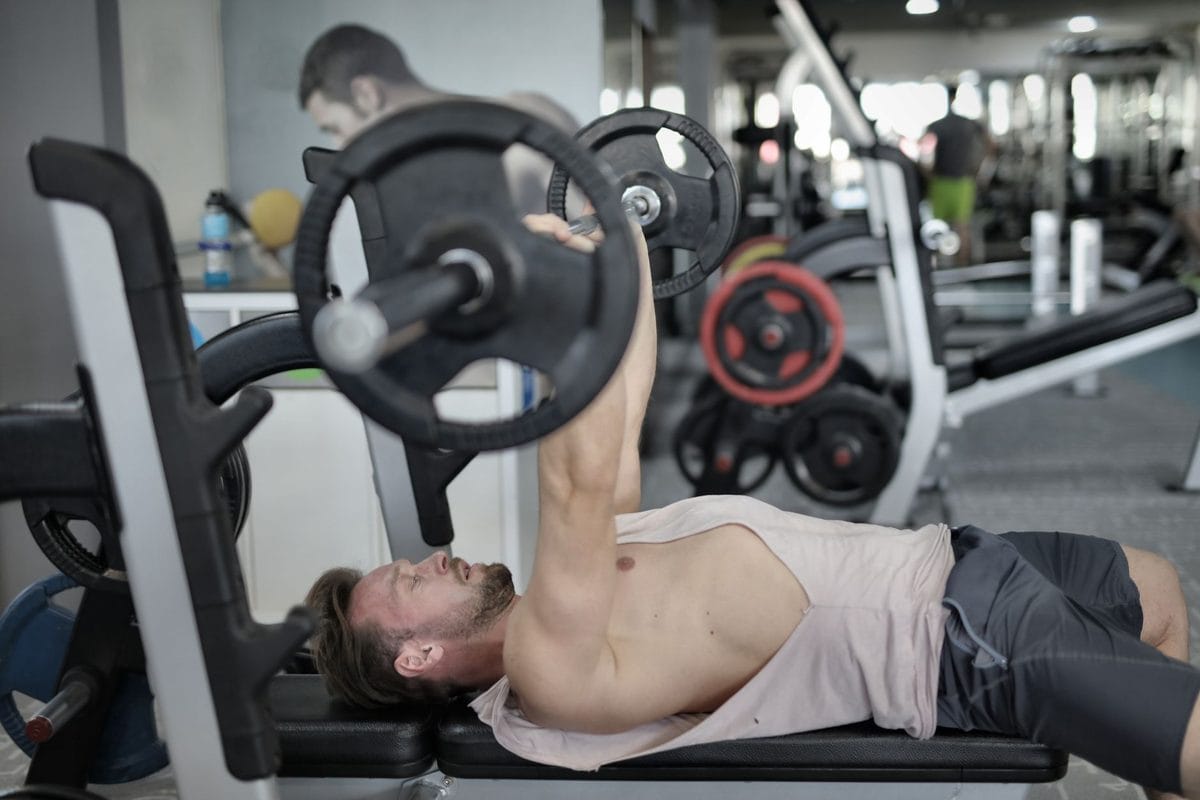
You set up under the bar, unrack it clean, and the descent feels fine. The bar touches your chest without a wobble. It even moves off your chest at a reasonable clip. Then, about three inches from lockout — exactly where the lift should be getting easier, not harder — the bar stalls, your elbows shake, and the whole set dies right there. Your training partner tells you to work on your chest. Your programme adds another incline dumbbell press variation. Your bench total doesn't move for two months straight, because the exercise everyone reached for was never aimed at the joint that actually failed. If that's your bench press, you've probably spent months chasing a "weak chest" that was never actually the problem.
Where the Bar Actually Stalls
Most lifters never check where their bench genuinely fails. They assume, because the chest is the muscle everyone talks about on bench day, that a stalled rep means a weak chest. Film your next heavy single from the side — a phone propped on a bench three metres away does the job — and you'll usually find one of three patterns: the bar stalls right off the chest, it grinds through a mid-range sticking point roughly two to four inches up, or it dies in the final stretch as your elbows approach full extension. Only the first pattern is genuinely a chest-and-front-delt problem.
The third pattern — the one this article is about — is a triceps problem, and it's far more common among lifters who've been benching for a year or more than most coaching forums admit. Once your pecs and anterior delts have done their job getting the bar moving, the final fifteen to twenty degrees of elbow extension is almost entirely triceps work. If that muscle group hasn't been trained specifically, no amount of extra bench volume, no amount of dumbbell flyes, and no amount of "just bench more" advice will close the gap.
The Force Curve Nobody Explains Properly
Here's the part most gym-floor advice skips: the muscles doing the pressing change throughout the range of motion, because the mechanical advantage of each muscle group changes as the joint angles change. Off the chest, the pecs and anterior delts have the best leverage and do most of the work. As the elbow straightens, the triceps' moment arm — the effective leverage it has on the joint — increases sharply, and by the last quarter of the lift the triceps brachii is the primary mover extending the elbow to full lockout. This is why the International Powerlifting Federation's technical rules require the bar to be pressed "to straight arms" with elbows locked before the down signal counts a rep valid — lockout isn't cosmetic, it's the single hardest mechanical position in the lift for anyone whose triceps lag behind their pressing strength.
This isn't universal, and it's worth saying plainly: some lifters, particularly those with long arms relative to torso length, stall closer to the chest even with strong triceps, because their sticking point sits earlier in the range where the chest and shoulders are still doing the heavy lifting. If you've filmed your bench and the stall is genuinely off the chest, more triceps work will do almost nothing for your total. Test before you programme.
Testing Whether Your Triceps Are the Real Limiter
Watch the bar path from the side before you change a single thing about your programme.
The cleanest test is a two-board press against your competition bench max. Have a spotter hold two stacked boards (roughly 3.8cm total) on your chest, press to that height, and compare how the weight feels against a full-range single at the same load. If a two-board press at your bench 1RM feels dramatically easier than the full-range version, your sticking point sits in the upper half and triceps strength is very likely your limiter — the board simply removes the range where the triceps have to finish the job. A second test: pin press or pause press starting from roughly two inches off the chest, at a pin height set inside a power rack. If you can grind that portion but still die at lockout, that confirms it further.
Building Lockout Strength Without Losing Bench Feel
Close-grip bench press belongs in every raw bencher's programme, full stop — not as a substitute for competition-grip bench, but as a dedicated lockout-strength builder run alongside it. Hands roughly shoulder-width apart (narrower than competition grip but not touching), elbows tracking at around 30 degrees from the torso rather than flared to 75 degrees, bar path touching lower on the chest than a wide-grip bench. This shifts a meaningfully larger share of the work onto the triceps without turning the movement into a skull crusher with a barbell.
Board press and JM press both deserve a slot too, though not in the same session as close-grip work — that's simply too much elbow-extension volume stacked on itself, and it shows up as tendon irritation within a few weeks rather than strength gains. A few options worth rotating through a training block:
- Close-grip barbell bench press, 3x5 at 70-75% of your competition-grip 1RM, once weekly
- Two-board or three-board press, 3x3 at 80-85% of full-range 1RM, once weekly
- JM press — a hybrid between a close-grip bench and a skull crusher — worked well for raw benchers going back to Marc Bartley and J.M. Blakley, the two lifters it's named after, and it still belongs in most triceps-focused blocks today
- Banded pushdowns or single-arm overhead extensions for higher-rep accessory volume, 3x15-20, using a medium resistance band
A set of resistance bands suitable for pushdowns and assisted work costs somewhere between £20 and £35 from a UK strength-equipment supplier such as Gymreapers or Bulldog Gear — cheap insurance against the elbow tendinopathy that heavy, high-frequency skull crushers tend to cause once you push past what your connective tissue can recover from.
Programming It Without Wrecking Your Bench Volume
The mistake most lifters make once they identify a triceps weakness is overcorrecting: they add close-grip bench, board press, JM press, and three different pushdown variations all in the same week, on top of their existing bench frequency, and wonder why their shoulders start aching and their actual bench numbers stagnate rather than improve. More elbow-extension work is not automatically better elbow-extension work — the triceps recover from heavy pressing volume more slowly than most lifters assume, and stacking three lockout-focused movements onto an already-full bench week just borrows recovery from the main lift. One or two dedicated triceps-lockout movements per week, layered onto an existing two-to-three-session bench frequency, is enough for the vast majority of intermediate lifters. Going beyond that adds fatigue without adding proportional strength, and it usually shows up first as a flat, grindy bar speed on your main bench sessions rather than as any obvious triceps soreness. Keep the accessory work honest instead: close-grip or board press on one day, light banded pushdowns on a second day if recovery allows, and nothing more until the numbers say otherwise. Track your two-board press number alongside your full-range bench for six to eight weeks; if the gap between the two closes while your bodyweight and joint comfort stay stable, the programme is working exactly as intended.
How Long Before It Shows Up in Your Competition Bench
Eight weeks is the realistic window, not two. Triceps hypertrophy and neural adaptation to a new movement pattern both take time, and lifters who abandon a close-grip and board-press block after three weeks because "the numbers haven't moved yet" are quitting right before the adaptation compounds. Re-test your two-board press against your full-range single at the end of week four as a checkpoint, not a verdict — a shrinking gap between the two numbers, even a small one, means the block is working and should run its full course. A gap that hasn't moved at all by week six is the actual signal to reassess grip width, elbow tracking, or whether the sticking point diagnosis was right in the first place.
Beginners, worth flagging separately, usually don't need any of this. If you've been benching under a year and your total is still climbing on general upper-body volume alone, adding a dedicated triceps-lockout block is solving a problem you don't have yet — that specificity pays off once general strength gains have slowed, not before. Save it for when your bench has genuinely plateaued for six to eight weeks running, which is usually somewhere in year two of consistent training for most natural lifters.
Common Mistakes That Undo the Work
Elbow position is where most of this work quietly falls apart. Lifters train close-grip bench and board press with disciplined, tucked elbows, then revert to a wide flare the moment they attempt a genuine max — and the triceps strength built in training never transfers, because the joint angles at lockout are different under a flared setup. Wrist position matters just as much and gets ignored almost entirely: letting the bar drift into the base of the palm rather than stacking it over the wrist bones costs real triceps leverage right where you need it most, particularly on a maximal attempt when grip fatigue makes that drift more likely.
Grip width inconsistency is the other quiet killer. "Slightly narrower than usual" is not close-grip bench — measure it, mark your bar with tape or chalk at the same finger position every session, and keep it there for the full training block. Skip the pin press test because it feels unnecessary, and you'll spend two months guessing at a fix instead of confirming one. The lifters who close the gap between their mid-range strength and their lockout are, almost without exception, the ones who tested first and programmed second.