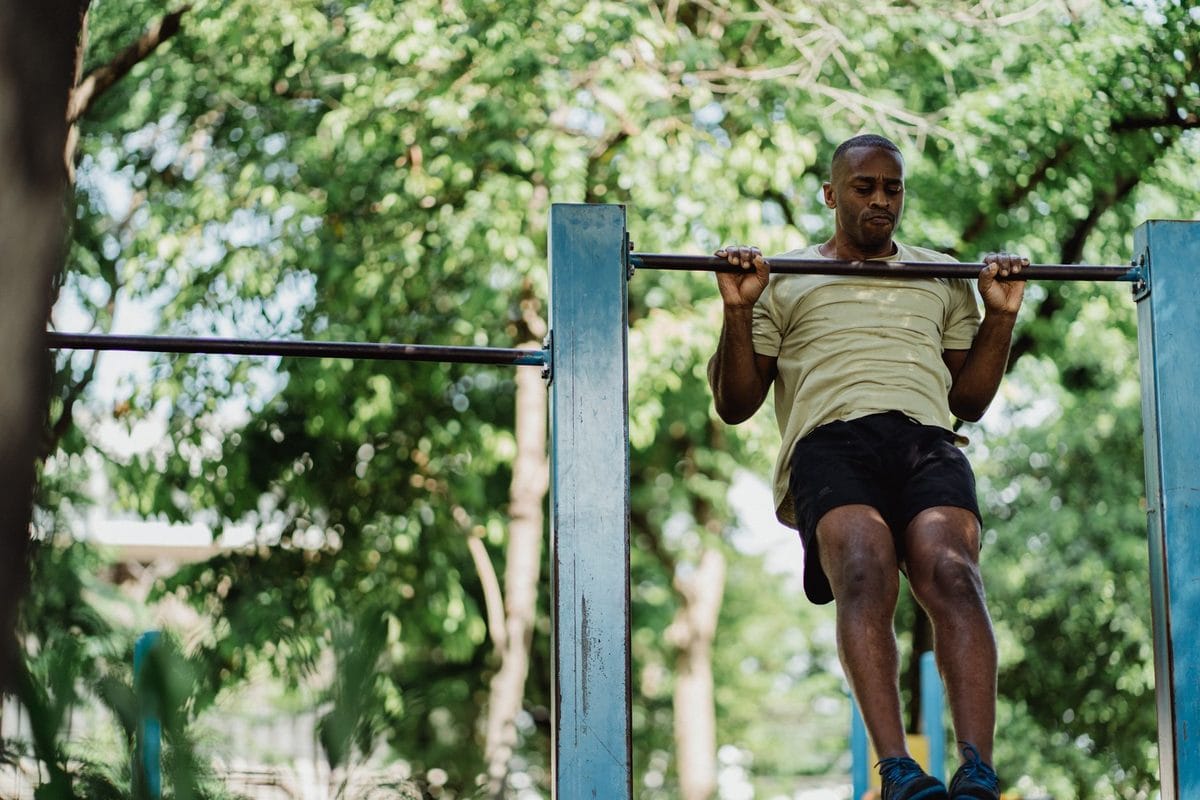
The first attempt at a pull-up usually goes the same way. Hands on the bar, a quick heave, and the chin stays well below it while the forearms start to burn. That result is not a verdict on your strength. It measures three things that can be trained separately: grip, shoulder control and the ability to lift your own bodyweight along a vertical path.
What the Pull-Up Actually Trains
The pull-up asks the lats, the upper back, the biceps and the grip to move your full bodyweight upward. It also needs the shoulder blades to control the start and finish of every rep, which is the part most beginners never think about. That combination explains why a man who can row a heavy weight may still be unable to get his chin over the bar. Strength in one pattern does not transfer neatly to the other.
Grip is usually the first limit men hit, and it is the easiest to train. Chalk, a towel thrown over the bar for a few hangs, or a thicker bar all raise the demand on the forearms without adding any load. Grip fatigue often ends a first attempt early, even when the back still has plenty left.
Be honest about the starting point. If you cannot hold a dead hang for about 20 seconds, the bottleneck is grip and shoulder tolerance, and more pulling practice will not fix that quickly. Measure the hang first, then build the plan from the number you find.
Build the Dead Hang First
Hang from the bar with arms straight and shoulders engaged, not shrugged up towards the ears. Aim for 20 to 30 seconds in a single go, with three sets and about a minute of rest between them. Two or three short sessions a week is enough at this stage. A doorway bar or a bar fixed in a garage will do, provided you check the manufacturer's weight rating and the fixing instructions, and look at the door frame for cracks or movement before the first hang. Hang with the thumbs wrapped around the bar rather than hooked over the top of it. Stop the hang the moment the shoulders drop into a shrug, because the shrug is where the useful work ends.
Keep the shoulders working even while hanging. Pull the shoulder blades gently down and away from the ears, keep the ribs down, and breathe steadily. A passive hang lets the shoulder joint carry the load, which is safe for a short time and adds little strength. An active hang keeps the shoulder blades working, and it is the version worth timing.
The NHS guidance for adults is to do strengthening activities on at least two days a week that work all the major muscle groups. A pull-up plan fits inside that routine as one part of a broader session, not as the whole programme. The same guidance treats strength work as separate from the aerobic minutes, so the pull-ups do not replace a run or a bike ride.
Two mistakes ruin this drill. Hanging passively with collapsed shoulders gives the lats nothing to do, and counting a hang that ends in a drop inflates the number. Stop when the grip gives way, and write the time down, because that figure is the one you are trying to raise.
Negatives: The Fastest Route to a First Rep
Why would a few weeks of slow lowering beat pull-downs on a cable machine? The lowering phase loads the same muscles that have to lift you, against your real bodyweight, which is why negatives are a common starting point for beginners. A negative is the descent: step or jump up to the top position with the chin over the bar, then lower as slowly as you can, aiming for three to five seconds. Do three sets of three to five negatives with about two minutes of rest between them. Ask a training partner to watch the top position, or film the set from the side. The aim is control rather than speed, and a three-second lowering is a demanding target for most men on a first attempt.
Put negatives first in the session, before any other pulling work. Fatigue ruins the slow lowering, and a rep that drops in the middle teaches less than a controlled set that holds all the way down. If three seconds is too hard, start at two and add time each week.
Set up the negatives so the top position is reached without a wild jump. A box or bench to step up from, a sturdy bar and a clear floor below are enough. Step down only once the chin is over the bar, and keep the lowering controlled rather than letting gravity finish the rep, because a sudden drop tends to strain the elbows and shoulders.
Band-Assisted Reps and Scapular Pulls
A loop resistance band hooked over the bar and under your knees removes part of your bodyweight. Choose one that lets you finish about six to eight reps at a controlled tempo, because a heavier band cuts the load and a lighter one helps less. A loop band typically costs around £10 to £25 in the UK, and it fits in a bag, which matters when the gym is out of reach in winter.
Mount the band with the top loop over the bar and the lower loop under both knees, so the band pulls up through the bottom of the rep. Check that the band does not slip and that the bar holds without flexing. A band that rolls off mid-rep is a fall risk, so test the setup with a few slow hangs first.
Scapular pulls are the smaller movement most beginners skip. From a dead hang, pull the shoulder blades down and back without bending the elbows, so the body rises a few centimetres. Do two sets of eight once or twice a week, because that is the movement that teaches the shoulders to start the pull.
Bands are not a shortcut. A band can hide a weak lowering phase, so keep at least one set of negatives in every week even when the band reps feel easy.
Testing Progress and Knowing When to Stop
Test the dead hang and the negatives every four weeks, using the same rules each time. A pull-up counts only when it meets three conditions:
- It starts from a full dead hang with the arms straight.
- The chin clears the bar without swinging or kicking.
- The descent is controlled, and the rep is counted only once the lowering is finished.
Stop if the pain sits at the front of the shoulder or the elbow, especially if it sharpens at the top or bottom of the movement. Burn in the back is effort, but a joint that catches or aches for more than a day after training is a signal to cut the volume. If the discomfort lasts longer than two weeks, see a physiotherapist before adding load.
Keep a short log of the dead hang time, the negative count and tempo, the band used and any pain score. A trend across four weeks is informative, while a single poor session tells you very little. Record the number even when it looks disappointing, because that entry is the one that shows where the plan needs changing.
If the numbers stall for two test cycles, change one variable at a time, such as the negative tempo or the band, and hold it for another two weeks before changing anything else. Changing three things at once makes it impossible to tell what helped.
Keep the Bar in Sight
A bar you walk past becomes the easiest place to add ten seconds of hanging, and that habit does more for the number than an occasional long session. Hang while the kettle boils, and the log will show the change week by week.