Walk into any gym on a Monday and you'll see the same ritual: three sets of crunches, a minute-long plank hold, maybe a few Russian twists with a ten-pound plate, then straight to the squat rack. Ninety seconds later that same lifter loses tightness through the ribcage two inches out of the hole, the bar drifts forward, and the set ends a rep short of what the warm-up sets predicted. The ab work didn't fail because it was skipped — it failed because it trained the wrong thing entirely.
What "core" actually means once a barbell is loaded
Crunches and sit-ups train spinal flexion — bending the trunk forward against resistance. That's a real skill, and it has a place in gymnastics and some combat sports. But under a loaded squat, deadlift, or overhead press, your spine isn't supposed to move at all. The job of the trunk in those lifts is the opposite of a crunch: resist movement while a load tries to bend, rotate, or shear it. Strength coaches call this bracing, and it runs on a completely different mechanism than a sit-up does.
Bracing works through intra-abdominal pressure. You take a breath into your belly and sides — not your chest — then contract the diaphragm downward against the pelvic floor and the abdominal wall outward against a tightened belt of obliques and transverse abdominis. The result is a rigid cylinder of pressure that turns your torso into a solid base the hips and shoulders can push against. Physical therapists sometimes describe this as filling a soda can with pressurized air rather than crushing it flat: an empty can folds under load, a fully pressurized one holds its shape even when you stand on it. A 225-pound deadlift pulled with a crunching, rounded spine and the same weight pulled with a properly braced, pressurized trunk are not the same exercise biomechanically, even though the bar moves the same distance. The lifter using the second technique is also the one who still has a healthy lower back in ten years, because the load gets distributed across the whole trunk instead of concentrated on a handful of lumbar segments.
Why crunch-trained abs still fail under the bar
A strong six-pack and a bulletproof brace are not the same trait.
A lifter can grind out 100 crunches and still lose bracing at rep four of a heavy squat set, because a crunch trains the rectus abdominis to shorten, not to resist a force trying to pull it apart. Under a loaded bar, the demand is almost always anti-extension (resisting the lower back arching too far), anti-rotation (resisting one side of the trunk twisting relative to the other), or anti-lateral-flexion (resisting the trunk tipping sideways, as in a heavy suitcase carry or a one-sided farmer's walk). None of the three shows up in a standard crunch, which is why lifters who train abs religiously with flexion work still see their bar path drift or their lower back round on a max-effort pull. The disconnect gets worse the stronger someone gets, too, because heavier absolute loads amplify any leak in the bracing pattern that a lighter bar could paper over. A lifter squatting 225 might get away with a soft brace for a few reps; the same soft brace under 405 shows up immediately as a forward lean or a rounding lower back. That's usually the point where someone finally asks a coach why their squat "feels unstable," when the honest answer is that their trunk was never trained to resist the forces a heavy bar actually produces.
This is not an argument that flexion work is useless — hanging leg raises and weighted sit-ups build real strength and have their place in a well-rounded program, particularly for lifters who also do gymnastics-style accessory work or want visible ab development. The mistake is treating flexion as the whole job. If bracing under load is the actual bottleneck on your squat and deadlift, three sets of crunches a week will not touch it, no matter how many reps you add.
The exercises that actually train bracing
Swap in movements that force the trunk to resist a force rather than generate one, and the carryover to the big lifts shows up within a few weeks. The following four cover all three planes of resistance:
- Pallof press (anti-rotation): band or cable set at chest height, press straight out and resist the pull trying to rotate your torso toward the anchor point. 3 sets of 8–10 reps per side, pause 2 seconds at full extension.
- Suitcase carry (anti-lateral-flexion): a heavy dumbbell or kettlebell in one hand, walk 40–60 feet without letting your ribcage dip toward the loaded side. This one transfers almost directly to keeping a deadlift bar path vertical.
- Dead bug (anti-extension, low back off the floor): lying on your back, press the low back flat against the ground and extend opposite arm and leg without letting it lift. Slow and controlled beats fast every time here — rushing the tempo is the single most common way people turn this into a useless drill.
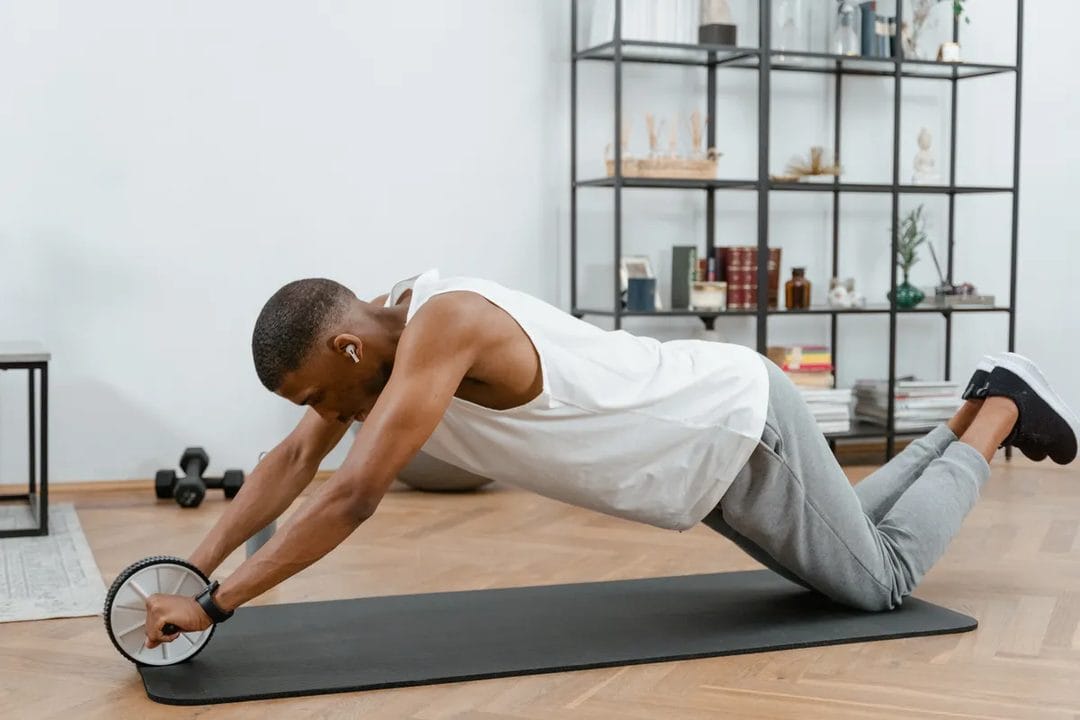
- Ab wheel rollout: from the knees to start, roll out only as far as you can maintain a flat lower back, and stop the moment it wants to sag. Rogue's standard steel wheel and the cheap plastic ones from a big-box store work identically for this — the exercise doesn't care about the equipment tier.
How bracing turns into pounds on the bar
The mechanism is straightforward: a rigid trunk transmits force from the hips to the bar without leaking energy into unwanted spinal movement. Picture the difference between pushing a loaded sled with a stiff push rod versus a rubber hose — the rod moves the sled, the hose just bends. A braced trunk is the rod. When the rectus abdominis, obliques, and deep spinal stabilizers hold the ribcage stacked over the pelvis through the entire rep, more of the force your legs and hips generate actually reaches the barbell instead of dissipating into lumbar flexion or lateral shift.
Lifters who add dedicated anti-rotation and anti-extension work typically report the improvement shows up first as consistency, not as a sudden PR — the bar stops drifting forward on heavy squats, the deadlift lockout stops grinding through a rounded lower back, and reps that used to fall apart at the sticking point start finishing clean. Give it six to eight weeks of consistent work before expecting the effect to show up on the platform; bracing is a motor pattern, and motor patterns take longer to groove than a muscle takes to get stronger.
Where this fits in your week
Core work belongs on the same days as your heavy compound lifts, not tacked onto a separate "ab day" that gets skipped when the week runs long. Program two Pallof press or suitcase carry sessions per week, paired with your squat or deadlift days, and one dedicated anti-extension movement like the dead bug or ab wheel on a lighter day. Keep total weekly volume for this category around 6–10 working sets — more than that and you're usually just adding fatigue without adding capacity, since bracing strength responds more to quality of tension than to sheer set count.
One thing worth calling out directly: if you're already dealing with lower back pain, a hernia, or a diagnosed core or pelvic floor issue, this is exactly the kind of training decision where a physical therapist or sports medicine doctor should weigh in before you load anti-rotation or anti-extension work — bracing mechanics interact directly with intra-abdominal pressure, and that's not something to self-diagnose your way through.
Common mistakes that cancel out the work
- Holding your breath instead of bracing against pressure — a true Valsalva brace pressurizes the trunk on an inhale and holds it, it doesn't mean turning purple on every rep.
- Doing anti-rotation work with too light a band or cable, so there's nothing real to resist — if you can hold the end position without any visible tension in the obliques, add load.
- Skipping the carry-over cue during the actual lift. Bracing drills only pay off if you consciously apply the same brace on your squat's unrack and your deadlift's setup — the skill has to be transferred on purpose, not absorbed by osmosis.
Try this on your next heavy squat session: take your normal bracing breath, then have a training partner press two fingers into your obliques right before you unrack. If the tissue gives more than a few millimeters, that's the gap between what your ab training builds and what your squat actually demands — and it's the gap the exercises above are built to close.