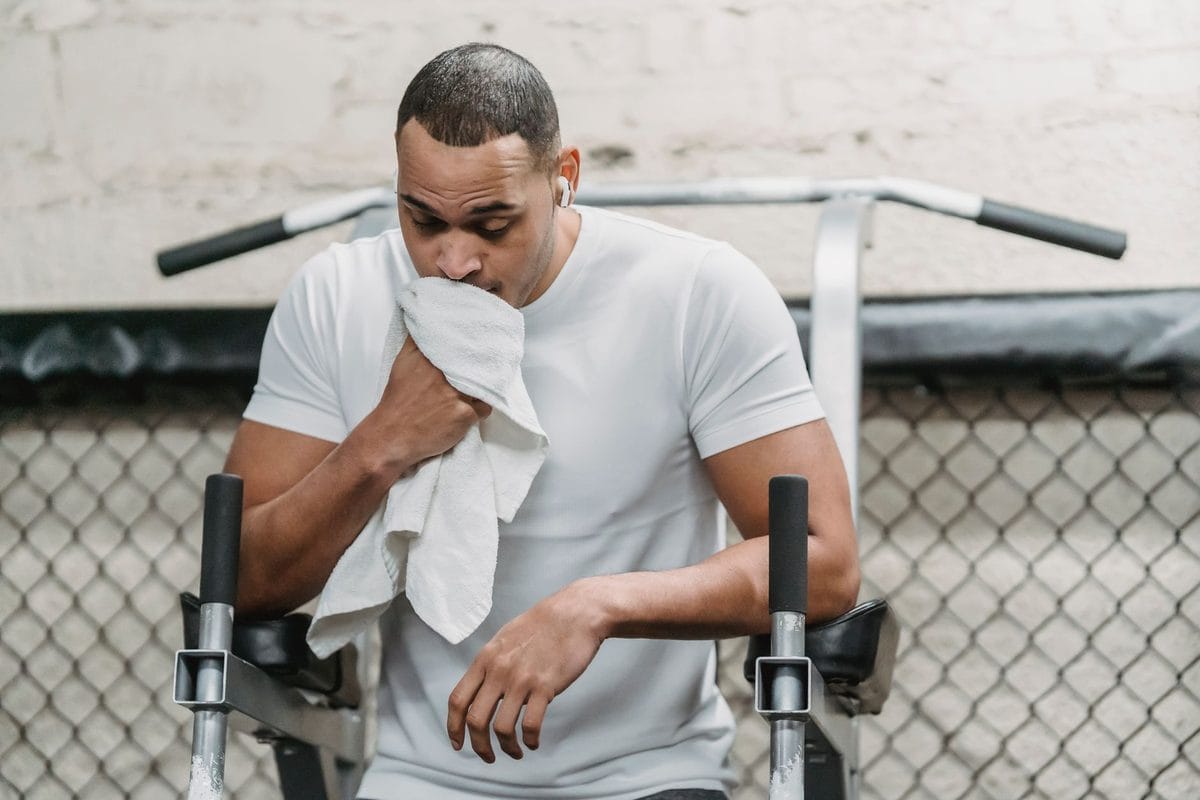
The alarm goes at 5:45, the kit bag is by the door, and the first thing you notice is your throat. It isn't sore enough to count as a sore throat, just rough, and your nose has quietly started to run. The logbook says Monday is a heavy day, a top set of five you have been chasing for three weeks, and every habit built by months of showing up says go. Online advice settles this in one line, either "sweat it out" or "never train ill", and both versions are wrong often enough to cost you something: a week of good training in the first case, a flat and miserable session that leaves you worse off in the second.
October is when this decision turns up in bulk. Sports-medicine papers on rhinovirus, the family of viruses behind many colds, routinely note that infections are most prevalent in autumn and spring, and the timing fits: schools and offices are back, trains are full, and somebody on every carriage is sniffing. So settle the rule now, while your throat is fine, because the person deciding at 5:45 with a thick head is the worst judge of it you will ever hire.
The neck check: where the line sits
The simplest triage tool in sports medicine is the "neck check", associated with the US sports physician Randy Eichner. Symptoms above the neck are the runny nose, the blocked sinuses, the sneezing and the mild sore throat. Symptoms below the neck are the hacking cough, the tight chest, the upset stomach and the general ache in your legs and back. Mayo Clinic's guidance says mild to moderate activity is usually fine with a common cold and no fever, that you should skip training with chest congestion, a hacking cough or an upset stomach, and that a fever, fatigue or widespread muscle aches also mean no exercise. It even points out that moving can temporarily open up a blocked nose, which is the grain of truth in "sweat it out". The rule is crude, and a cold that starts above the neck can drift below it overnight, so check on the day rather than trusting yesterday's verdict. It is still the best single filter available, because it asks one question you can answer in ten seconds: is this a nose problem or a whole-body problem?
What the one famous experiment actually showed
The reassurance that gentle training is safe with a cold leans heavily on a 1998 trial led by Thomas Weidner, published in Medicine & Science in Sports & Exercise. Fifty volunteers aged 18 to 29, all of moderate fitness, were deliberately infected with rhinovirus 16 on two consecutive days. Thirty-four of them then did 40 minutes of supervised exercise every other day at 70% of heart-rate reserve for ten days, while sixteen did not. The researchers collected and weighed used tissues, a wonderfully unglamorous measure of symptom severity, and also tracked a symptom checklist every twelve hours; from day two to day ten, the two groups did not differ.
That is a useful result with clear edges. The volunteers were young, the virus was a single mild one, the exercise was prescribed by heart rate rather than by load on a bar, and nobody had flu. A 2009 review of exercise and respiratory infections in Exercise and Sport Sciences Reviews pointed out that, for ethical reasons, experiments like this are restricted to viruses that cause only mild symptoms, which leaves illnesses such as influenza untested. Read the study as permission to train lightly with an ordinary cold, and nothing more. It says nothing in favour of a grinder session and nothing at all about being feverish.
Fever and flu are a hard stop
The NHS describes the difference between the two clearly: a cold arrives gradually over a couple of days, affects mainly the nose and throat, and leaves you well enough for your normal activities, while flu appears within a few hours, affects more than the nose and throat, and leaves you exhausted and too unwell to carry on as normal. If you wake up aching all over with a sudden high temperature, you are on the flu side of that table, and the neck check never even comes into it. Harvard Health's advice for anything that brings high fever, muscle aches and fatigue is to wait until the fever has gone, make the first workout back light enough that you don't get out of breath, and progress slowly. Mayo's warning is blunter: train at normal intensity with more than a simple cold and you risk injury or a more serious illness.
Two rules of thumb sit on top of that. If you need paracetamol or ibuprofen to feel fit enough to lift, you are not fit enough to lift, because a masked temperature is still a temperature. And a chesty cough rules out heavy squats and deadlifts on its own, since both ask you to take a huge breath, brace against it and hold it, which a tight chest turns from a technique cue into a coughing fit.
Running a lighter session with an ordinary cold
If everything sits above the neck and your temperature is normal, Harvard's suggestion is to cut intensity and duration in half, then build up gradually if you feel fine later in the day, and to take an extra day off if the session leaves you exhausted. Translated into lifting terms, that looks like this:
| Variable | Normal day | Cold day (above the neck only) |
|---|---|---|
| Intensity | As programmed | Top set capped at RPE 6, with four or more reps left in the tank |
| Working sets per lift | As programmed | About half |
| Session length | Usual | 30 to 40 minutes |
| Leave out | Nothing | Max attempts, sets to failure, breathless conditioning finishers |
That table is a lifter's reading of Harvard's halving advice, not a protocol anyone has tested in a trial, so adjust it to how you feel. The point of the session is to keep the movement patterns warm and the habit alive. The rep PR can wait until your nose clears.
What a few days off cost you
So does skipping Monday mean losing the top set you have been chasing?
No, and the evidence here is reassuring. Mayo's own line is that a few days off while sick shouldn't affect your performance. A 2013 meta-analysis by Bosquet and colleagues, covering 103 studies of resistance-training cessation, did find that stopping reduces strength, but the loss grew with the length of the break, and it was larger in people over 65, and, for maximal force and power, larger in inactive people than in recreational athletes. In a 2013 study by Ogasawara and colleagues, 14 young men did bench press three days a week, either continuously for 24 weeks or in three six-week blocks separated by three-week breaks. Their overall gains in muscle size and strength ended up similar. The catch is that those were young men training one lift, and nobody ran the experiment on lifters in their forties, so treat three weeks off as an outer limit rather than a plan.
The NHS says you should begin to feel better from a cold in about one to two weeks, but that does not mean two weeks without a bar in your hands, because the above-the-neck days can be trained light. Take the rest days at the start, when you feel worst. The trade is lopsided: a few days off cost you almost nothing measurable, while one heavy session on a run-down body buys you ugly reps and a decent chance of passing the cold to whoever is on the next bench.
Coming back: a three-session ramp
Harvard's phrase for the return is "low and slow", and it is worth turning into numbers before you are standing at the rack feeling heroic. Start counting from the day you are fever-free and clearly improving, not from the first morning your nose stops running.
- First session back: working weights at roughly 70% of your last ones, half the usual sets, nothing near failure, no conditioning finisher. You should leave feeling you could have done more.
- Second session, whenever you would next normally train: about 85% of your last weights and two-thirds of the sets.
- Third session: your programme as written, but with the top set at RPE 7 instead of 8 or 9. The next session after that is business as usual.
These percentages are a judgement call, not a research finding. If any session leaves you wiped out for the rest of the day, Harvard's rule applies: take another day off before the next one.
Gym etiquette when you're contagious
A runny nose is not a quarantine order, but a cold is contagious and a bench is a shared surface. The NHS asks anyone with a high temperature, or who doesn't feel well enough for normal activities, to stay at home and avoid other people, and Mayo adds that you shouldn't exercise around other people if you have a contagious illness. If you are coughing and sneezing visibly, train at home with a kettlebell or skip the day. If you go in with a mild above-the-neck cold, go off-peak, wipe the bench and handles before and after, and don't ask a stranger for a spot.
What not to spend money on
The NHS is flat on this: there is little evidence that supplements such as vitamin C, echinacea or garlic prevent colds or help you recover faster. What the NHS does recommend for flu is plain rest and sleep and plenty of water, enough that your pee stays light yellow or clear, and nothing in a tub of "immune support" powder beats a full night in bed on the days you most want to grind through a session.
When to stop guessing and ring someone
The NHS lists several reasons to see a GP rather than keep self-managing: a high temperature for more than three days, symptoms that get worse, feeling short of breath or having chest pain, cold symptoms that haven't improved after ten days, a cough lasting more than three weeks, or cold symptoms on top of a long-term condition such as diabetes or a heart, lung or kidney condition. If a deliberately light session back leaves you short of breath or with chest pain, stop and get it checked rather than assuming it's deconditioning.
Write the rule in your logbook tonight, while your throat is fine: above the neck, half the session; below the neck or running hot, no session; back in three steps. The version of you who wakes up at 5:45 with a rough throat will argue a lot less with a line he wrote himself.