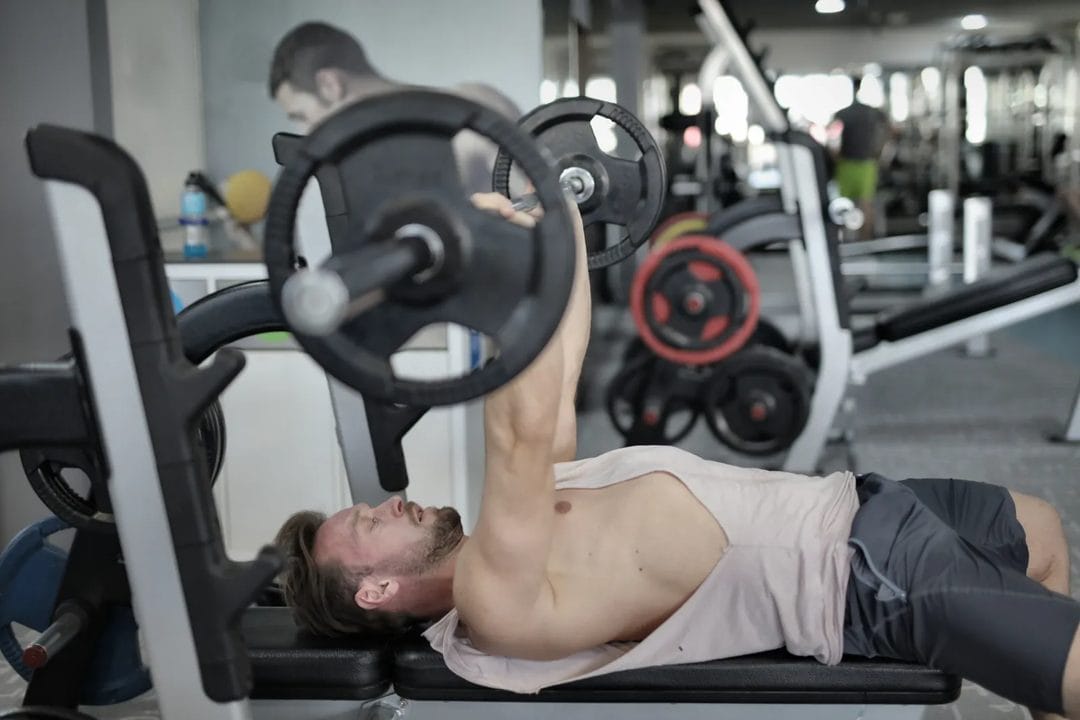
Most guys who bench 225 for reps have never lowered a weight they couldn't lift back up. That's the gap. You can be strong on the way up and still be leaving a huge chunk of the training stimulus on the table, because the muscle-building and joint-protecting work happens just as much on the way down as it does on the way up — and almost nobody trains that half of the rep on purpose.
Eccentric contraction is the lengthening phase: the bar lowering to your chest on a bench press, your body descending into a squat, the bar dropping toward your shins on a deadlift's final inches before the plates touch the floor. It's the part every lifting cue tells you to control — "don't drop it," "own the negative" — but almost no one actually programs it as its own variable. That's a mistake, and the research on why is more specific than most lifters realize.
Why the Lowering Phase Produces More Force Than the Lift
Muscle can generate roughly 20-50% more force eccentrically than it can concentrically, depending on the muscle group and velocity tested. This isn't a training trick — it's basic contractile physiology. When a muscle lengthens under load, fewer motor units and cross-bridges are needed to resist a given force compared to shortening against that same load, which is why a spotter can help you grind out one more concentric rep on bench but you can almost always lower far more than you can press. Your body is built to absorb force eccentrically before it's built to produce it concentrically.
That force differential is exactly why the eccentric portion of a lift creates more mechanical tension and more microtrauma per rep than the concentric portion does. Mechanical tension is one of the primary drivers of hypertrophy, and eccentric contractions deliver it at a lower metabolic cost — you fatigue less per unit of tension generated. That's the physiological hook. What it means in practice is that a controlled 3-4 second lowering phase on your working sets is quietly doing more for muscle growth than the same rep performed with a fast, uncontrolled drop.
What the Research Actually Shows
The most cited synthesis here is Roig et al.'s 2009 systematic review and meta-analysis in the British Journal of Sports Medicine, which pooled trials comparing eccentric-emphasized training to concentric-only training. The finding: eccentric training produced greater gains in both maximal strength and muscle cross-sectional area than concentric training at matched relative intensities. It wasn't a marginal edge — the effect sizes for hypertrophy favored eccentric work consistently enough that strength coaches still cite it as the baseline argument for why negatives belong in a program at all.
There's a second body of evidence that matters just as much for anyone training past 35: eccentric loading is the standard rehab and prevention protocol for tendinopathy. The Alfredson heel-drop protocol — originally developed for chronic Achilles tendinopathy and still the reference standard nearly three decades later — uses slow, controlled eccentric heel drops, typically three sets of fifteen reps twice daily for twelve weeks, to rebuild tendon stiffness and collagen alignment. Tendons don't adapt to lifting the same way muscle does; they respond specifically to the loaded lengthening phase, which is part of why patellar and Achilles tendon issues so often trace back to programs that are all concentric snap and no controlled descent.
Tempo Prescriptions: What "4010" and "3111" Actually Mean
Coaches write tempo as a four-digit code: eccentric seconds, pause at the bottom, concentric seconds, pause at the top. A prescription of 4010 means a 4-second lowering phase, no pause at the bottom, a 1-second lift, and no pause at the top. 3111 slows things down further on both ends — a 3-second eccentric, a 1-second pause in the stretched position, a 1-second concentric, and a 1-second pause at lockout. These aren't arbitrary numbers pulled to look scientific; they're a way to force time under tension in the specific phase that drives the most adaptation, especially useful when someone habitually free-falls the bar and never feels the stretch position at all.
Here's the part that surprises people: slowing the tempo on every single rep isn't automatically superior once you control for total training volume and effort. A well-known tempo study by Schoenfeld and colleagues found that when sets were taken to failure and total volume was equated, a very slow lowering phase (something like 8 seconds) produced hypertrophy results roughly comparable to a normal-speed lowering phase around 1-2 seconds. The advantage of eccentric work isn't really about turning every rep into a slow-motion exercise — it's about deliberately controlling the phase you'd otherwise rush through, and occasionally overloading it beyond what you could lift concentrically.
Eccentric Overload: Negatives and Assisted Reps
This is where eccentric training earns its keep for intermediate and advanced lifters. Because you can lower more than you can lift, you can load a bar to 105-120% of your concentric 1RM, have a spotter help you into the top position, and lower it under control for a true supramaximal eccentric — a stimulus your muscles literally cannot access through normal lifting. This works best on bench press and squat, where a spotter can safely assist the concentric portion after you've controlled the negative.
For pull-ups, negatives are the more practical route to a first strict rep than band-assisted concentrics. Jump or step to the top position, then lower yourself over 5-8 seconds for 3-5 reps across 2-3 sets. Band-assisted pull-ups train the wrong strength curve — the band gives you the most help at the bottom, exactly where you need the least, and takes help away at the top, where you need it most. Weighted negatives don't have that problem, and they build the specific eccentric strength that stabilizes your shoulder through the descent, which is usually the part that breaks down first anyway.
The Soreness Bill Comes Due
Eccentric-emphasized training produces disproportionately more delayed-onset muscle soreness than concentric work at the same load, because the microtrauma from lengthening under tension is mechanically different from the fatigue of shortening contractions — more Z-disc disruption, more inflammatory response, more of the soreness that shows up 24-48 hours later and peaks around day two. First exposure to unaccustomed eccentric loading can leave you sore enough to affect the next several training sessions, not just the next day.
The good news is the repeated bout effect is real and well-documented: after that first bout of unfamiliar eccentric loading, your muscles adapt structurally, and subsequent sessions targeting the same movement produce dramatically less soreness and damage even at equal or higher loads. That's not an excuse to load up heavy negatives cold, though.
Ease into eccentric-overload work with two to three lighter exposure sessions before you touch anything near 110% of your concentric max, and never introduce a new eccentric-focused movement in the week before a meet, a max-effort test, or anything else you need your legs and shoulders fresh for.
How to Actually Program It
Save eccentric overload work for your accessory or secondary lifts, not your daily competition-style squat or bench — the soreness cost is too high to stack on top of the movements you're testing or peaking for. A better slot is a controlled-tempo main lift (3-4 second eccentric, normal concentric) paired with a true overload negative on a secondary variation once a week, such as spoto-press negatives after your regular bench day or eccentric-only step-downs after squats.
- Controlled tempo on primary lifts: 3-4 second eccentric, brief pause, normal-speed concentric — every working set, every week
- True eccentric overload (105-120% load, spotter-assisted concentric): 1x per week per muscle group, 2-3 sets of 3-5 reps, and this is genuinely taxing enough that more than that will eat into your recovery for everything else
- Bodyweight negatives for skill work — pull-ups, dips, pistol squats — 2-3 sets of 3-5 reps, 2x per week
- Rotate which movement gets the eccentric-overload slot every 3-4 weeks so the same joint isn't absorbing peak eccentric stress indefinitely
If you're over 35 and dealing with a cranky patellar or Achilles tendon that flares up under normal training, controlled eccentric loading — not rest, not avoidance — is the intervention with the strongest evidence behind it. Start light, stay consistent for six to eight weeks before judging whether it's working, and don't confuse the DOMS from a new eccentric protocol with the joint pain you're trying to fix; they feel different once you've paid attention to both.
The lift you're already doing has an eccentric phase built into every single rep. You're either wasting it by dropping the weight as fast as gravity allows, or you're using it as the second half of the exercise it was always meant to be.