He still pulls 405 off the floor without much drama, and his bench has crept past 275 over the last year of patient programming. But three weeks ago, chasing his eight-year-old across the backyard in a game that was supposed to be nothing, he pulled up short on the first burst — not winded, just slow, like his legs had a half-second delay built in that wasn't there five years ago. Nobody warns you about that part at 35 and up. The numbers on your big lifts can keep climbing while the quality that actually gets you through the world — how fast you can produce force, not how much of it you can eventually grind out — quietly walks out the door first, usually without you noticing until a kid, a dog, or an icy sidewalk makes you notice.
Strength and Power Are Not the Same Skill
Maximal strength is how much force you can generate given as much time as you need to generate it. A five-rep back squat at 90% of your max is a strength test — nobody cares if the bar moves slowly, only that it moves. Power is a different question entirely: how much of that force you can produce in a fraction of a second, the difference between grinding a heavy squat up over two or three seconds and exploding off the ground into a jump. Your nervous system treats these as separate skills with separate training demands, and they age on separate timelines. Fast-twitch muscle fibers, the ones responsible for rapid, explosive contractions, lose contractile speed earlier and faster than the slow-twitch fibers that carry you through a heavy, grinding set — which is exactly why plenty of men in their late 30s and 40s keep hitting personal records on a five-rep squat while their vertical jump, their sprint start, and their ability to catch themselves off a curb quietly decline in the background. Strength training, done consistently, protects the engine. It does almost nothing on its own to protect the ignition switch.
That gap is the entire reason a program built purely around slow, heavy compound lifts leaves a hole. A powerlifting-style approach — squat, bench, deadlift, add weight, repeat — builds tremendous maximal force production and does very little to train how quickly that force gets applied. You can be strong and slow at the same time, and most lifters over 35 who've been training seriously for a decade are exactly that: strong, and slower than they think.
Why This Actually Matters Day to Day
Skip the gym for a second. Rate of force development — how fast you can go from zero force to useful force — is the thing standing between you and catching yourself when you trip on a curb, reacting to a car that brakes hard in front of you, or getting off the ground quickly after your kid tackles you on the living room floor. It's also, not coincidentally, one of the better predictors of fall risk and independence in older adults, which sounds like a problem for your 70s until you remember that the decline starts showing up in your 30s and accelerates through your 40s and 50s if nothing pushes back against it. A man who can squat 315 for reps but can't jump twelve inches off the ground has built a strong base with a hole in the roof.
Athletic recreational leagues expose this fast. A weekend basketball run, a pickup soccer game, a tennis match against someone twenty years younger — these punish rate of force development in a way the weight room rarely does, because sport demands force applied in tenths of a second, not seconds. Guys who've spent three years exclusively on slow strength work often find themselves gassed and sluggish in these settings despite having objectively strong numbers on the bar, and the mismatch is confusing until you understand that they've been training one adaptation while sport demands the other.
The Work That Actually Trains It
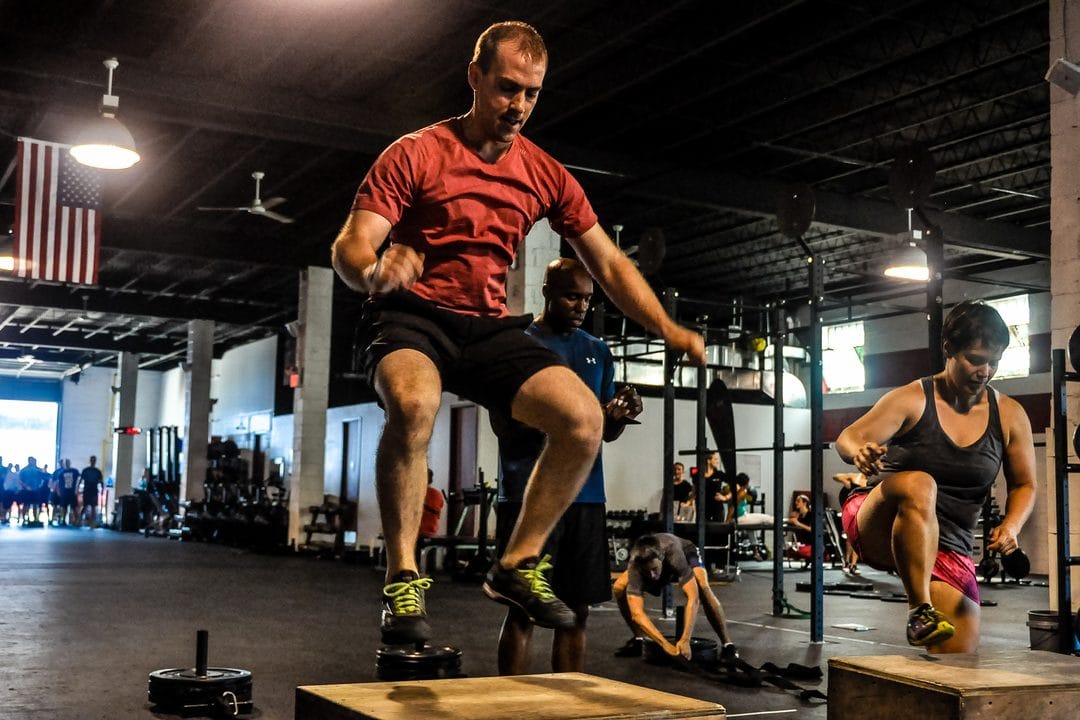
Box jumps are the standard entry point, and for good reason: the box gives you a defined target and removes the eccentric landing stress that makes jumping onto flat ground harder to recover from. Step down after each rep instead of jumping back down — the landing is where most of the joint stress lives, and stepping down keeps the exercise about producing force rather than absorbing it. Medicine ball slams and rotational throws train the same explosive intent through the upper body and core, and they're forgiving on the joints in a way heavy overhead work isn't. Kettlebell swings, done for power rather than for a conditioning burn, teach hip snap at speed. And jump squats with just your bodyweight or a light load — far lighter than your working squat weight — reinforce the same explosive pattern your heavy squat never touches, precisely because a heavy squat is, by definition, not fast.
Skip depth jumps until you've built a real base of box jumps and jump squats first. The reactive landing stress in a depth jump is genuinely useful once your tendons and connective tissue are ready for it, but loading that kind of eccentric force onto a 40-year-old Achilles that's spent three years doing nothing but squats and deadlifts is how you end up explaining to a physical therapist why you can't walk without a limp. Build the base first. There's no shortcut here worth taking.
How to Program It Without Wrecking Your Lifts
Power work goes first in the session, always, right after your warm-up and before your main strength lift — fatigue is the enemy of speed, and a nervous system that's already been taxed by heavy squats has nothing left to produce a genuinely fast rep. Keep the volume low: three to five sets of three to five reps is plenty, with full recovery of two to three minutes between sets. That's a fraction of the volume you'd use for a hypertrophy block, and that's the point — this isn't conditioning, and treating it like conditioning defeats the entire purpose of the exercise.
Twice a week is enough for most lifters. Once a week still moves the needle if your schedule is tight, and the return on the first six weeks of consistent power work tends to be the steepest most men will see from any single addition to their program — a noticeably higher vertical, quicker off the line in whatever sport they play, less of that half-second lag chasing the kids in the yard.
The Mistake That Turns Power Work Into Just More Conditioning
Most men who add jump training do it wrong in the same specific way: they chase a burn.
Twenty box jumps in a row with thirty seconds of rest between sets is a solid conditioning circuit. It is not power training, no matter how tired it makes you, because by rep eight your nervous system has stopped producing a maximal explosive effort and started producing a fatigued, sloppy approximation of one — which trains you to jump slow under fatigue, the exact opposite of the adaptation you're chasing. The tell is in the landing: watch your first rep and your tenth rep on video and if the second one looks noticeably worse, you've already blown past the point where the set was doing what you wanted. Quality over quantity isn't a platitude here, it's the entire mechanism — every rep needs to be close to your best effort, or you're just doing cardio with extra steps.
There's a real edge case worth naming honestly: if you're carrying an existing knee or ankle injury, or you're returning from one, jumping work needs a green light from whoever is treating you before it goes anywhere near your program. This kind of training loads joints hard and fast, and "explosive" is precisely the wrong word to introduce into a joint that isn't ready for it yet.
What a Week Actually Looks Like
- Monday — box jumps, 4x4, before squats
- Wednesday — medicine ball rotational throws, 3x5 per side, before your upper-body pressing work
- Friday — kettlebell swings for power, 5x3, before deadlifts, plus a set of jump squats if you're feeling fresh
That's the whole addition — three short blocks bolted onto training you're presumably already doing, adding maybe eight minutes to each session. No extra day at the gym, no separate "athleticism" program to plan around, and no need to touch your existing strength work beyond moving it to happen after the power sets instead of before them.
A guy who's been strength training for years and adds this in doesn't usually notice much in the first two weeks. By week six, most men report the same thing without prompting: stairs feel different, a mis-step doesn't turn into a stumble the way it used to, and whatever recreational sport they play on the weekend stops feeling like it's happening half a beat behind everyone else. That's the whole return on eight minutes, three times a week — not a bigger number anywhere, just getting back a piece of speed that strength training alone was never going to give him.