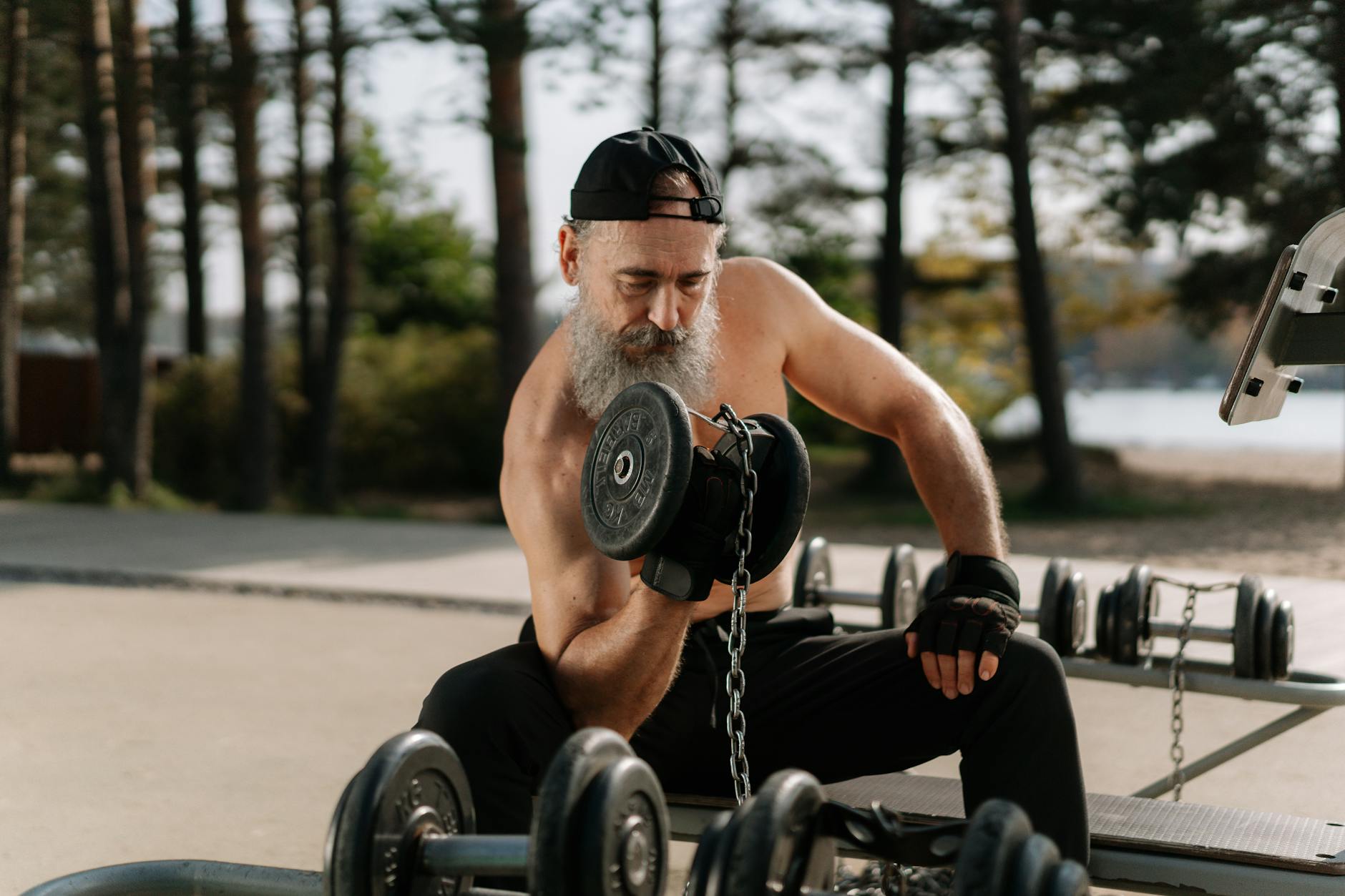
At 42, my squat is 20 pounds under my lifetime best. It's also higher than it was at 36, when I spent a year training stupidly and paid for it with a torn lower back that kept me in PT for nine months. Training after 40 isn't about doing less. It's about doing smarter — and understanding which parts of the program you can't get away with anymore.
The problem is that most training advice is written for 25-year-olds. Their recovery is fast, their joints are forgiving, and their hormones are at peak. At 40, none of those are true anymore. A program that worked when you were 27 will break you now — not because it was wrong then, but because you're a different system.
What actually changes
Three things shift meaningfully once you cross 40, and every program adjustment you'll make is downstream of understanding them.
1. Recovery slows
Protein synthesis rates are slightly lower. Inflammation clears more slowly. Tissue repair — tendons especially — takes longer. In raw numbers, recovery between hard sessions extends by 12 to 24 hours compared to a 25-year-old doing identical work. That's not crippling, but it's real.
Translation: you can't hit the same muscle group every 48 hours at full intensity anymore. 72 hours between heavy sessions for the same lift becomes the practical minimum for most 40-plus lifters.
2. Connective tissue stiffens
Collagen turnover slows. Tendons get stiffer and less compliant. Cartilage has less water content. The practical effect: joints that were silent at 30 start talking at 40, and the warning signs for injury get subtler. What used to be a minor tweak is now a six-week recovery.
This is why warm-ups stop being optional. A 35-year-old can walk in and deadlift heavy off a cold start. A 45-year-old trying the same thing is buying himself a bulging disc.
3. Hormones drift
Total testosterone drops roughly 1 percent per year after 30. Growth hormone pulses shrink. Insulin sensitivity worsens. All of these are small year-over-year changes — but by 45, you're looking at a substantially different endocrine environment than you had at 25. Recovery, body composition, and training tolerance all feel it.
What doesn't change
The foundational principles still work. Progressive overload still drives strength. Compound movements still do more than isolation work. Total protein intake, sleep, and stress management are still the three biggest levers. Nothing about turning 40 suddenly makes isolation curls more effective than deadlifts.
The guys who train well into their 60s — Mark Rippetoe, the guys in Starr's writing, the over-50 lifters who show up on Elite FTS — did not abandon barbells at 40. They adjusted programming variables around a stable core of compound training.
The adjustments that actually matter
Here's what I've changed between 35 and 42, in roughly the order I made each change:
- Full warm-ups, every session: 10 to 15 minutes of ramp-up sets, mobility work, and priming. Non-negotiable now.
- Training frequency per muscle dropped: from 3x/week to 2x/week on the same volume total.
- Lowered max effort frequency: RPE 9+ attempts once a week max, and only on one compound lift.
- Added Zone 2 cardio: 2 sessions of 40 minutes weekly for recovery and cardiovascular health.
- Mandatory deload every 5 to 6 weeks: no more "maybe I'll deload next month" — it's on the calendar.
The volume trap
The biggest mistake I see in 40-plus lifters is trying to maintain the volume they did at 30. The recovery demand creeps up, but they don't track it. So they end up chronically fatigued, plateau, and blame the program.
Actual number: most 40+ lifters do better dropping their total weekly volume per muscle group by 20 to 30 percent from what they ran at 30, and keeping intensity in the same range. The total work is lower. The quality of each set is higher. Recovery gets ahead of accumulation instead of trailing it.
Intensity handling
RPE 10 training becomes expensive fast past 40. Central nervous system fatigue accumulates and takes longer to clear. The guys still making progress in their 40s are lifting in the RPE 7 to 8 range for the bulk of their work sets, with occasional RPE 9 singles or doubles for true max effort work.
This means your heaviest squat of the week might be 4 at 385 rather than the old 5 at 405. On paper that's a decrease. In reality, the 4 at 385 is recoverable, stacks week over week, and doesn't break you. The 5 at 405 cost a week of recovery for a rep you'll forget.
What matters more now
Three variables that barely registered in my 30s dominate my training in my 40s: sleep, mobility, and soft tissue work.
Sleep becomes quantifiable. Eight hours versus seven hours used to be a rounding error. Now it's the difference between a strong Tuesday and a session where 315 feels heavy. Track your sleep, target 7.5 hours minimum, and accept that late-night TV is stealing strength.
Mobility work — real mobility, loaded end-range stuff, not butterfly stretches — earns its place in the warm-up. 10 minutes of hip mobility, thoracic extension, and shoulder dislocates before squats becomes protective rather than optional.
Soft tissue work — foam roller, lacrosse ball, massage gun — moves from "nice to have" to "scheduled." Ten minutes at the end of sessions, or 20 minutes on a rest day, keeps the chronic low-grade fascia issues from turning into real injuries.
What to stop doing
Two things I've stopped and don't miss. Max effort deadlifts every week. Heavy singles on anything more than once a month. The risk-to-benefit ratio on those has shifted. In your 20s, you had a decade of tissue tolerance bank. In your 40s, every near-max pull draws down a smaller account.
I still deadlift heavy. Just not to a true one-rep max. The heaviest pull I do is typically a triple at 90 percent, and that's twice per training block — not every week.
The long view
The goal at 40 isn't the same as the goal at 25. At 25, you're optimizing for peak output. At 40, you're optimizing for continued output over the next 25 years. Those are different optimization problems, and they produce different programs.
Done right, training at 40-plus isn't a fight against entropy. It's the most sustainable strength work you'll ever do. Slower progression, but also fewer setbacks. Less drama. More compounding.